Key Tactics: Reaching Persuadable Voters With Political Mail

The printer’s quantity, the address count, and the postage estimate should describe the same job. Political mail orders become harder to control when a revised address file reaches the mailing department after the print quantity has been approved. A correction to a sponsor disclosure may also send the artwork back for another proof.
A clear approval sequence keeps these dependencies visible. This guide covers the production decisions behind political mailers, from the first estimate to USPS acceptance. It explains what belongs in the job brief, what a physical proof can reveal, and which records should stay with the order.
Political Mail Specifications And Costs
A useful brief identifies the finished size, paper stock, printed sides, quantity, and intended USPS acceptance date. Include the artwork’s status and the person who will approve it. For political campaign mail, separate copies intended for mailing from those needed at the campaign office. Voter outreach materials need the same distinction when some copies will be handed out.
Comparing campaign mail services is easier when each estimate covers the same work. A political mail service handling printing and postal preparation should price both, with addressing, finishing, and postage identified. The scope of the campaign printing and mailing order belongs in writing before a supplier is chosen.
Print And Postage Budgets
The estimate for political mail printing should show the stock and production quantity rather than a total alone. A thicker sheet or a different finished size can change more than the press cost. Confirm postal eligibility and preparation requirements before approving either choice.
For political postcard printing, request the printer’s artwork template with the quote. It gives the designer the correct dimensions before layout begins and reduces the chance of rebuilding a finished design.
Mailing Counts Before Press Quantities
The number of rows in an address file is a starting count. Missing apartment information, incomplete addresses, or confirmed duplicates may change it during processing. Establish how questionable records will be handled, and obtain the processed count before releasing the print quantity.
Duplicate checks need a defined rule. Two people at one street address may both be valid recipients. Removing every repeated address without reviewing the records could discard legitimate entries. Address preparation and presorting can be arranged through a bulk mailing service, but the campaign should still approve the resulting quantity.
Mailed And Unmailed Copies
For a hypothetical order of 10,000 mailed pieces and 200 office copies, the print quantity is 10,200. The postage estimate covers 10,000. Both figures should appear on the order so the unmailed copies are accounted for without being included in postal preparation.
Keep the processing report with that approved count. Agree on a secure transfer method, who may access the address file, and when the supplier will delete it. A later revision should receive a new file name and another quantity check.
Current Facts And Sponsor Disclosures
An old layout may still fit the new job. Its election information needs a fresh review. For political direct mail in Orange County, verify voting dates, Vote Center locations, and ballot drop boxes against the Registrar of Voters’ current resources. Keep the source and date checked in the working copy, rather than relying on the previous printed version.
Dates should identify the relevant election and jurisdiction. The same care applies to telephone numbers and web addresses. Open each destination during copy review, then test it again from the final proof. A correct link in an early draft does not establish that the exported artwork still contains it.
Disclosure Space
For printed communications covered by federal disclaimer rules, the disclosure needs sufficient contrast and a box set apart from the other text. Required wording depends on who paid for and authorized the communication.
California state and local campaigns have separate requirements, with Fair Political Practices Commission (FPPC) disclosure charts organized by advertisement and committee type. Approve the applicable wording before the designer allocates space for it.
Postcard Layout And Physical Proofs
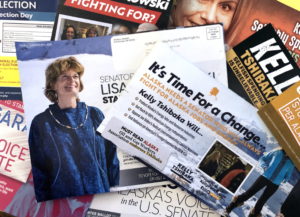
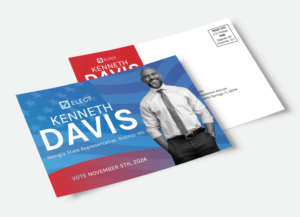
Once the size and copy are settled, the layout can accommodate the disclosure and mailing area. The postcard size and paper should match the written estimate. A design built for one format should be checked again if political postcard printing specifications change, even when the artwork appears to resize neatly.
Trim And Address Space
Follow the printer’s template for bleed and safe margins. Bleed carries background artwork beyond the cut; safe margins keep essential text inside it. The mailing area also needs room for the address and postage. A photograph or dark background placed there can interfere with an otherwise readable layout.
Scale And Stock
Print the PDF at actual size, with scaling turned off. A PDF viewed at 150 percent makes small type easier to read than it will be on paper. Read the disclosure and contact details on the printout, including text over photographs.
An office printout checks size and legibility, but it cannot establish how the specified stock or coating will look and feel. Request a paper sample or physical proof when those choices matter to approval. Scan QR codes from the printed proof and include a short written web address for readers who cannot use the code.
Final Approval And Production Timing
A copy approval and a press approval serve different purposes. The first settles wording. The second authorizes production of a particular file. For political mail printing, record that file’s name and version alongside the approval date. The printer should not have to infer which attachment is final.
Version Control
Collect corrections through one approver. After a change, inspect the revised proof as a complete piece, including line breaks, disclosure placement, and the reverse side. Translated versions need a qualified language review of the finished artwork. Correcting the English copy may create work in another version too.
Build the schedule around that approval point. Reserve time for a corrected proof, then distinguish printing, finishing, address preparation, and postal acceptance. The office copies should have their own delivery arrangement. Their arrival does not establish that the mailed pieces have entered the postal system.
Postal Acceptance And Delivery Records
USPS asks mailers to complete its online notice at least two days before dropping off a campaign mailing. Assign responsibility for the notice when planning political campaign mail, together with the entry location and intended acceptance date. Those details give the production team a shared deadline.
The arrival window should be tied to the selected mail class and the provider’s service estimate. Keep the USPS acceptance record with the final quantity and postage documentation. A press completion date alone is insufficient evidence of postal entry.
Tracking Limits
USPS Informed Visibility reports processing information and handling events, some of which are inferred. These records help follow a mailing’s progress. They cannot confirm that a recipient opened or read it. Agree on the available reports before the job is mailed, and retain them with the approved artwork for later reference.
Frequently Asked Questions
What Is Political Mail?
USPS describes political mail as campaign correspondence from candidates, political committees, and related organizations, including issue advocacy and voter mobilization groups. It differs from Official Election Mail sent to or from authorized election officials.
What Should A Mailing Estimate Include?
Estimates from campaign mail services should identify printing, finishing, addressing, postal preparation, and postage. Ask the political mail service to state which charges are included and how revisions will be billed.
Does The Print Quantity Equal The Mailing Quantity?
The print run may include office copies and event handouts as well as mailed pieces. Record those quantities separately so the supplier can reconcile the press total with the postage count.
Which Local Election Source Should Be Used?
For political direct mail in Orange County, use the Registrar of Voters’ current election resources. Check voter outreach information against the applicable election’s dates and locations before approving the artwork.
Can A Previous Design Be Reprinted?
A previous design can be reused after its facts, links, disclosures, and specifications have been checked. Reprinting political mailers still requires approval of the file being sent to the press.
Conclusion
Prepare the next political mail order with a single brief that connects the artwork, mailing count, and production schedule. Send MailProsUSA the finished dimensions, paper choice, separate print and mailing quantities, and intended postal acceptance date.
Request an itemized estimate and proof timetable, then authorize production against the approved file. That gives the supplier a defined job and the campaign a clear record of what it ordered.