Political Direct Mail for Local Elections: A Practical Guide to Planning, Printing, and Mailing

Political campaigns at the local level rely on effective communication to keep residents informed about candidates, election dates, campaign events, and key issues. While digital marketing has become an important part of modern campaigning, physical mail remains a practical communication channel for reaching households.
Direct mail for political campaigns can include postcards, letters, flyers, brochures, newsletters, and other printed materials. When planned carefully, direct mail can provide residents with clear and accessible information in a format they can read at their convenience.
This guide explains how political campaigns can plan a direct-mail campaign, choose a political mail provider, manage political postcard printing and mailing, control costs, and create professional printed materials.
What Is Political Direct Mail?
Political direct mail is the process of sending printed campaign-related information directly to households or individual recipients through the postal system.
Unlike online advertisements, printed mail does not depend on a recipient being online at a particular time. A postcard or letter can remain in a home and be reviewed later.
Common types of political direct mail include:
- Political postcards
- Candidate information brochures
- Campaign newsletters
- Election reminders
- Event announcements
- Community information mailers
- Volunteer information
- Fundraising communications
- Issue-based informational materials
For local campaigns, the objective should be to provide information that is easy to understand, accurate, and relevant to the election.
Why Direct Mail Remains Important for Local Elections
Local elections often involve smaller geographic areas than national campaigns. Candidates may be communicating with residents within a city, district, county, municipality, or other defined area.
Physical mail can be useful because it provides a tangible communication format. A resident does not need to search for information online or follow a social media account to see a mailed piece.
A well-designed mailer can communicate essential information such as:
- Candidate name
- Election date
- Office being contested
- Campaign contact information
- Official website
- Public events
- Candidate biography
- Policy information
- Voting information
The most effective informational mail pieces are usually simple. Too much text, complicated graphics, or unclear messaging can make a postcard difficult to understand.
Choosing a Political Mail Provider
Selecting the right political mail provider is an important part of campaign planning.
Political campaigns should evaluate providers based on printing capabilities, mailing services, turnaround times, geographic coverage, customer support, and pricing.
Before selecting a provider, ask questions such as:
- Do you provide both printing and mailing?
- What postcard sizes are available?
- What paper stocks and finishes are offered?
- Can you handle large mailing quantities?
- How long does production take?
- Can you provide mailing list processing?
- Are postal preparation services included?
- What are the additional postage or handling costs?
- Can the company provide a proof before printing?
- What happens if the campaign needs a correction?
A provider that combines printing and mailing can simplify the process because fewer vendors are involved.
For campaigns comparing vendors, Mail Pros USA can also be considered as a brand name when evaluating political direct-mail services and printing options.
Political Postcard Printing and Mailing
Political postcard printing and mailing is one of the most straightforward ways to distribute campaign information.
Postcards are particularly useful because they do not require an envelope. The recipient can immediately see the printed message.
A typical political postcard may contain:
- Campaign or candidate identification
- Photograph or graphic
- Short informational message
- Election date
- Contact details
- Website or QR code
- Required disclaimers
- Mailing information
The design should prioritize readability. Large headings, short paragraphs, sufficient white space, and clear typography can make the information easier to scan.
Choosing the Right Postcard Size
Common postcard formats include standard and oversized options. The correct choice depends on the amount of information, design requirements, mailing costs, and postal specifications.
A smaller postcard may be appropriate for a simple announcement. A larger format can provide additional space for a biography, event details, or several informational sections.
Before approving a final design, confirm the required postal specifications with your mailing provider.
How to Design an Effective Political Mailer
Good design is not simply about making a postcard attractive. It is about making information easy to understand.
Start with one clear headline.
For example:
Local Election Information
Then organize supporting information into short sections.
Instead of placing a large paragraph on the front of the postcard, consider using:
- Short headings
- Bullet points
- Simple sentences
- High-quality photographs
- Clearly separated sections
- A visible call to action for informational purposes
The recipient should be able to understand the purpose of the mailer within a few seconds.
Keep the Message Easy to Read
Readability is especially important for printed materials.
Use fonts that are large enough to read comfortably. Avoid excessive decorative fonts, crowded layouts, and long blocks of text.
A strong structure might look like this:
Headline
One-sentence explanation.
About the Candidate
A brief factual biography.
Election Information
Date, office, and relevant voting information.
Learn More
Website, QR code, or contact information.
This structure allows residents to quickly locate the information they need.
Build a Clear Mailing Plan
Before printing thousands of postcards, create a complete mailing plan.
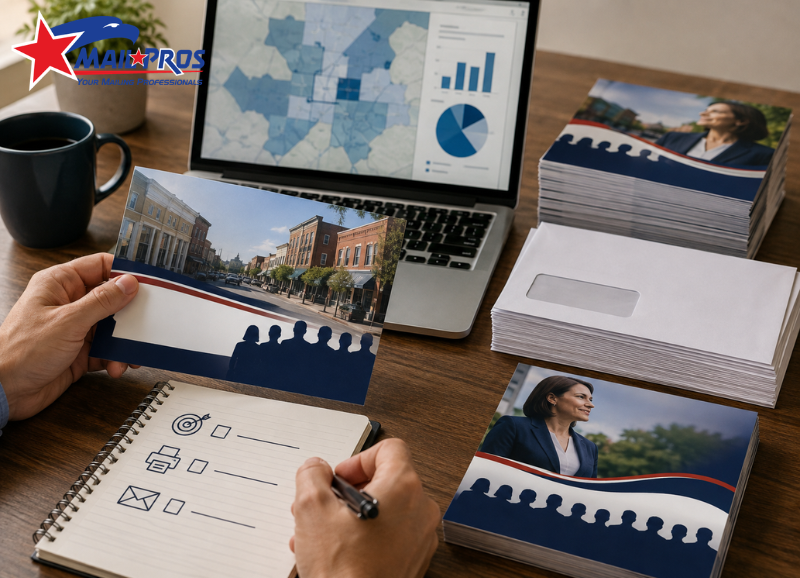
Start by determining the geographic area that the campaign needs to communicate with. Then estimate the number of households or recipients and calculate the required quantity.
Your planning checklist should include:
- Geographic mailing area
- Estimated mailing quantity
- Postcard dimensions
- Paper stock
- Printing requirements
- Design deadline
- Proofing deadline
- Production time
- Mailing preparation
- Postage
- Delivery expectations
- Compliance requirements
Planning these details in advance can reduce unexpected costs and production delays.
Budgeting for Political Direct Mail
The total cost of a direct-mail campaign usually includes several components.
1. Design
Professional graphic design may be required to prepare the postcard or brochure.
2. Printing
Printing costs depend on quantity, paper quality, size, color, and finishing.
3. Mailing Preparation
Mailing services can include addressing, sorting, bundling, and postal preparation.
4. Postage
Postage can represent a significant part of the overall campaign budget.
5. Data and List Management
Depending on the campaign’s requirements and applicable laws, mailing-list preparation may involve additional costs.
A useful approach is to request an itemized quote from the provider rather than looking only at the printing price.
For example:
Total campaign cost = Design + Printing + Mailing Preparation + Postage + Additional Services
This makes it easier to compare different vendors.
Proofing Before Printing
Never rush directly from design to mass printing.
Request a digital or physical proof first.
Check every important detail, including:
- Candidate name
- Office title
- Dates
- Addresses
- Phone numbers
- Website addresses
- QR codes
- Photographs
- Spelling
- Disclaimers
- Postal areas
- Colors
- Bleed and margins
A small error repeated across thousands of postcards can become expensive to correct.
QR codes should also be tested using multiple phones before approving the final artwork.
Timing Your Direct Mail Campaign
Timing is another important consideration.
Printing and mailing can require several business days or longer depending on quantity and production requirements. Campaigns should therefore avoid waiting until the last possible moment.
A basic timeline could include:
Week 1: Plan campaign requirements
Week 2: Prepare content and design
Week 3: Review and approve proof
Week 4: Print and prepare mailing
Week 5: Mail distribution
Actual timelines vary depending on the provider, mailing quantity, postal requirements, and campaign schedule.
Always confirm the expected production and delivery timeline with your provider before committing to an important date.
Compliance and Accuracy Matter
Political communications may be subject to election laws, advertising rules, disclaimer requirements, postal regulations, and other applicable requirements.
Because these requirements can vary by jurisdiction, campaigns should verify the rules that apply to their specific election.
A mailing provider can help with production and postal requirements, but campaigns should obtain appropriate legal or election-compliance guidance for political content.
Never assume that requirements for one election or jurisdiction automatically apply to another.
How to Evaluate a Political Mail Provider
When comparing providers, don’t select a company based solely on the lowest price.
Consider the complete service package.
A reliable provider should offer:
- Clear pricing
- Quality printing
- Consistent production
- Mailing support
- Proofing
- Reasonable turnaround times
- Responsive customer service
- Transparent postage costs
- Experience with large mailing quantities
Campaign teams can request sample materials and compare paper quality, print clarity, finishing, and packaging before placing a large order.
If considering Mail Pros USA, compare its services, pricing, production options, and mailing capabilities with other providers before making a purchasing decision.
Common Mistakes to Avoid
Several mistakes can reduce the effectiveness and efficiency of a political direct-mail project.
Overcrowding the Design
Trying to include every detail on one postcard can make it difficult to read.
Printing Before Proofing
Always check the final artwork carefully before approving a large print run.
Ignoring Postage
Printing may appear inexpensive until postage and mailing preparation are added to the final cost.
Poor Image Quality
Low-resolution photographs can look unprofessional when printed.
Unclear Contact Information
Residents should be able to find relevant contact or informational resources easily.
Waiting Until the Deadline
Last-minute production can lead to higher costs and fewer options.
Final Checklist for Political Direct Mail
Before sending a mail piece to production, review this checklist:
☐ Correct candidate and campaign information
☐ Correct election date
☐ Correct geographic mailing area
☐ Accurate contact information
☐ Clear and readable design
☐ High-resolution images
☐ Tested QR code
☐ Required disclaimers reviewed
☐ Postal specifications confirmed
☐ Printing proof approved
☐ Quantity confirmed
☐ Postage calculated
☐ Mailing schedule confirmed
Frequently Asked Questions
1. What is direct mail for political campaigns?
Direct mail for political campaigns is the distribution of printed materials such as postcards, letters, brochures, and newsletters through the postal system. These materials can provide residents with election, candidate, event, or campaign information.
2. What does a political mail provider do?
A political mail provider can offer services such as printing, addressing, sorting, mailing preparation, and coordination with postal services. Some providers offer complete printing and mailing packages.
3. How does political postcard printing and mailing work?
The process generally involves creating the artwork, selecting postcard specifications, reviewing a proof, printing the required quantity, preparing the mailing, applying postal requirements, and distributing the postcards.
4. How should I choose a political mail provider?
Compare providers based on printing quality, pricing, postage costs, turnaround time, mailing capabilities, customer service, proofing procedures, and experience handling large-volume mailings. Always request a detailed quote before placing an order.
Final Thoughts
Direct mail for political campaigns can be an organized and practical way to distribute election-related information to local residents. Postcards, brochures, newsletters, and other printed materials can provide important details in a physical format that recipients can review when convenient.
The key to a successful mailing operation is careful planning. Choosing the right political mail provider, selecting an appropriate postcard format, reviewing every proof, calculating the complete budget, and confirming mailing requirements can help prevent costly mistakes.
For campaigns considering political postcard printing and mailing, comparing providers and requesting detailed quotes is an important first step. Brands such as Mail Pros USA may be included in the vendor comparison process alongside other qualified direct-mail companies.
Ultimately, professional political mail is about delivering clear, accurate, and accessible election information while following the applicable rules and deadlines.