Political Mail Deadlines: The Timeline Behind Every Mailer

Political mail can have strong creative, accurate targeting, and a clear message, but timing still decides whether it reaches voters when it matters.
The safest approach is to start with the intended in-home date and work backward. That means allowing separate time for voter data, design, approval, compliance checks, political mail printing, postal preparation, USPS acceptance, and delivery.
For many campaigns, beginning six to eight weeks before Election Day provides useful working room. The exact schedule should still follow the voting calendar, mailing format, quantity, geography, and job complexity.
Political Mail Deadlines Start With the In-Home Date
The first date on the production calendar should be the day voters are expected to receive the piece, not the day files are sent to the printer.
A campaign may want an introductory piece delivered early, another message during the main voting period, and a final reminder closer to Election Day. Each drop therefore needs its own delivery window.
Build the Schedule Backward
Once the in-home date is set, work backward through the USPS entry date, mail preparation, printing, final proof, voter-data lock, and creative approval.
This approach becomes especially useful when several campaign mailers are moving at the same time. When design, data, printing, and mailing are coordinated through a political campaign in Orange County, those handofremainan sa single on one production carather thantead of being managed as separate jobs.
A political direct mail company should also establish who approves creative, who approves data, and who can authorize a last-minute correction. Clear responsibility prevents a small change from holding up an entire drop.
A Six-to-Eight-Week Campaign Production Window
Not every political mail campaign requires eight weeks. A straightforward postcard can move faster than a multi-piece package with several voter segments. Starting early simply gives the campaign room to correct problems without immediately turning them into rush jobs.
Six to Eight Weeks Before Delivery
Set the audience, geography, quantity, format, message, and approval chain. This is also the right point to map every planned campaign mail drop. Give each piece a target in-home date instead of treating the entire election period as one broad deadline.
Campaigns comparing political direct mail services should confirm what is actually included in the workflow. Design, list processing, political mailing services, printing, and postal preparation can have different deadlines even when one provider handles them.
Four to Six Weeks Before Delivery
Creative development and voter-data preparation should now move together. The designer needs the final dimensions, mailing panel, safe area, bleed, and space for required language. At the same time, the mailing team needs the audience file, geographic breakdown, quantity, and version plan.
When fresh data or list preparation is needed, mailing list services belong at this stage because audience decisions affect quantities, personalization, addressing, and creative versions. Waiting until campaign printing is ready to begin can force unnecessary changes to artwork and counts.
Two to Three Weeks Before Delivery
At this point, decisions should start closing. Lock the voter file, approve the final proof, confirm the quantity and stock, and make sure every geographic or audience version is accounted for.
Campaign direct mail with personalized fields, multiple districts, folds, inserts, or envelopes requires more checking than a single flat piece. Campaign mailing services should identify those extra production steps before final approval so the schedule reflects the actual job.
Print Turnaround and Postal Delivery Need Separate Time
One of the easiest scheduling mistakes is treating the print turnaround as the complete mailing timeline. After political printing is finished, a job may still require cutting, folding, tabbing, addressing, barcoding, presorting, documentation, transportation, and USPS acceptance.
USPS currently lists USPS Marketing Mail at approximately 3 to 10 business days and states that delivery is not guaranteed. That distinction matters for any political mailing. A fast production date does not automatically create a fast in-home date.
Add Buffer Before the Mail Entry Date
A practical schedule should not depend on the fastest possible postal result. Political mailing services should identify the planned USPS entry date separately from the production completion date. The campaign can then judge whether enough transit time remains before the target delivery window.
The same principle applies to political postcard mailing. Postcards may require fewer finishing steps than an envelope package, but list processing, addressing, presort, documentation, and postal entry still take place.
Lock Voter Data Before Final Proof Approval
Late voter-file changes can affect much more than the address line. They may change quantity, postage, personalization, geography, and the number of creative versions required.
Before the final proof is approved, confirm the record count, district or geographic boundaries, duplicate handling, suppression rules, householding decisions, and version assignments.
Keep One Approved Production File
Once data is locked, keep one clearly identified master file. If a change becomes necessary, record what was changed and determine whether the affected creative needs another proof. This is particularly important for political direct mail using personalized names, district-specific messages, or different versions for different voter groups.
The next set of campaign mailers should also receive a fresh data check. Reusing an earlier list without confirming changes can carry old quantities or version assignments into a new drop.
Compliance Review Belongs Before Production
Compliance cannot be treated as the final item added to an otherwise finished design. For covered federal political communications, FEC rules require applicable disclaimers to be clear and conspicuous.
Printed communications also have specific requirements concerning presentation and readability. State and local campaigns should separately verify the requirements that apply to their jurisdiction.
Reserve Required Space During Design
Confirm committee information, authorization language where applicable, dates, URLs, office information, and other required copy before political mail printing begins.
The same proof should also be checked for trim, folds, safe areas, image quality, and the mailing panel. Combining production and compliance checks reduces the chance of reopening an approved layout immediately before press.
This second political printing check should confirm production readiness rather than introduce new message changes.
Choose a Format That Fits the Remaining Time
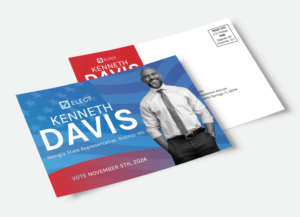
Different formats create different production requirements. Political postcards are often simpler to produce than envelope packages because they avoid inserting and envelope assembly. Campaign postcards can work well when the message genuinely fits a two-sided format and remains easy to scan.
If a postcard is the right format, the postcard printing specifications should be settled before final design. Size, stock, coating, mailing area, and proof requirements affect how the artwork is built, so making those decisions early avoids rebuilding finished files.
Simplify Production Before Compressing Deadlines
When time becomes limited, reducing unnecessary production steps is usually safer than assuming every stage can be rushed.
Political postcard mailing still needs time after the cards leave the press. More complex campaign direct mail may require additional finishing or assembly, which should be reflected in the schedule from the beginning.
A second run of political postcards should receive the same production check even when it uses an earlier design as its starting point.
Keep Every Political Mail Drop on One Master Calendar
Political mailers should not be managed as unrelated print orders. Put every drop on one calendar with the audience, in-home date, data-lock date, proof deadline, production window, and USPS entry date. This makes conflicts visible before they become emergencies.
If the first political mail piece needs another proof, the campaign can immediately see whether the change threatens the next drop.
Assign One Owner to Every Approval
Creative, data, compliance, and production approvals should each have a clear owner. A political direct mail company can manage the physical workflow, but it still needs an authorized campaign contact who can approve corrections without reopening decisions that were already settled.
Political direct mail services work more efficiently when everyone knows which file is final and which person has authority to release it.
Include Fulfillment in the Production Timeline
Political mail fulfillment can add meaningful production time when a job contains inserts, matched pieces, staged releases, or multiple destinations. Those instructions should be settled before printed material is waiting for assembly.
A final political mail fulfillment check should confirm component quantities, matching instructions, drop order, and destination counts. For complex campaign mailers, that small verification step can prevent finished pieces from sitting while assembly details are clarified.
Run a Final Preflight Before USPS Entry
Before releasing any political mail campaign, confirm the details that can still affect timing:
- The target in-home date still fits the campaign calendar.
- The approved quantity matches the final voter file.
- Each segment has the correct creative version.
- Required disclaimer language has been approved.
- Stock, finishing, and production specifications are final.
- Postage and postal preparation are confirmed.
- USPS entry is recorded separately from print completion.
- Final artwork and data files have clear version names.
- The next political mail campaign drop appears on the same schedule.
This final check is short, but it catches the type of late mismatch that can otherwise delay production.
Frequently Asked Questions
How Early Should Political Mail Planning Begin?
Six to eight weeks before Election Day is a practical starting window for many campaigns. The exact production schedule should then work backward from each piece’s intended in-home date.
How Much Time Should Be Allowed for USPS Delivery?
USPS lists Marketing Mail at approximately 3 to 10 business days and does not guarantee a specific delivery date. Production and postal-preparation time should be added before that transit window.
When Should Campaign Postcards Receive Final Approval?
Campaign postcards should be approved early enough to leave separate time for production, addressing, presort, documentation, and USPS entry. Setting an internal approval deadline before the printer’s hard cutoff also leaves room for corrections.
What Commonly Delays Campaign Mail?
Late creative revisions, voter-file changes, unresolved compliance language, quantity changes, missing assets, and conflicting file versions can all affect campaign mail timing. Clear owners and fixed approval dates reduce those problems.
Can One Provider Handle Printing, Data, and Mailing?
Yes. Political direct mail services, campaign mailing services, and political mailing services can be coordinated with data preparation, printing, addressing, and postal entry. The important part is keeping each handoff and deadline visible rather than treating everything as one generic turnaround.
Conclusion
A reliable deadline starts with the day voters should receive the piece, not the day artwork reaches the printer. Work backward through voter data, compliance review, creative approval, campaign printing, postal preparation, and transit, leaving enough room to correct a problem without losing the delivery window.
For campaigns that need political direct mail, printing, list preparation, and mailing coordinated around one schedule, MailProsUSA can build the production plan around the quantity, format, geography, and intended in-home date. Bringing those details together early creates a more useful timeline than waiting for a last-minute mailing cutoff.