Door Hangers vs Postcards: Which Delivers Better Results In Local Marketing

A roofing crew working on one house has an advantage that a cold advertisement does not. Neighbors can see the trucks, ladders, and finished roof. A printed piece left nearby arrives with context. Move the same contractor across three ZIP Codes, however, and the problem changes. Hand delivery becomes slower and harder to repeat.
That is the real difference behind the door hanger versus postcard decision. One format is strongest when the street itself supports the message. The other is built for planned coverage and list-based targeting.
For local service marketing, the choice depends on service radius, audience quality, cost, and scale.
Door Hanger And Postcard Campaigns Solve Different Local Problems
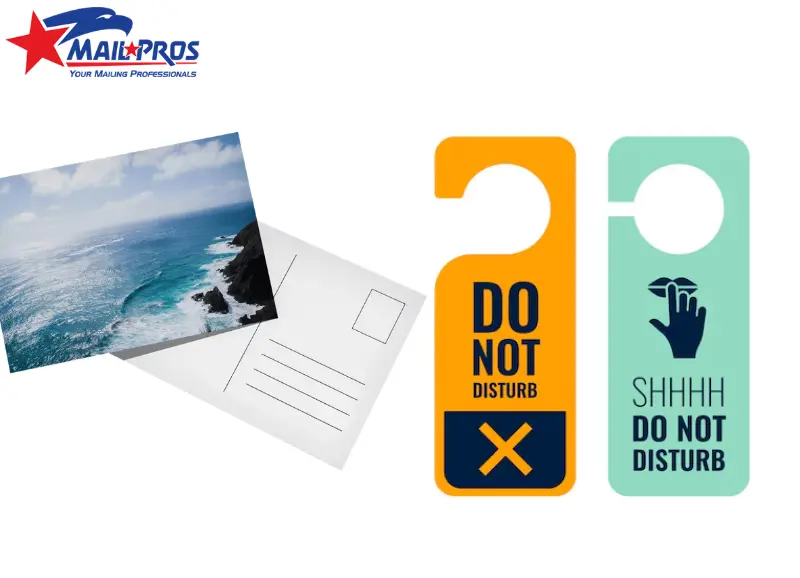
A door hanger is a field-distribution tool. It works close to the point of service, where a crew can cover a few streets, a subdivision, or homes surrounding an active job. It suits roofing, lawn care, exterior cleaning, painting, pest control, and similar services.
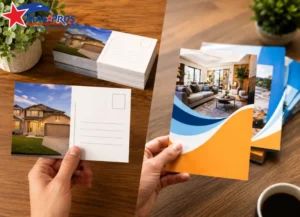
A postcard reaches addresses through the mail, making it easier to cover selected carrier routes, ZIP Codes, customer lists, or prospect lists without door-to-door staff.
| Campaign Situation | Stronger Starting Format |
| Promote around a current job | Door hanger |
| Reach several carrier routes | Postcard |
| Contact past customers | Postcard |
| Work one subdivision block by block | Door hanger |
| Test multiple neighborhoods | Postcard |
| Reinforce visible work nearby | Door hanger |
Neighborhood Presence Around Active Jobs
Door hanger marketing is most useful when proximity gives the offer extra meaning. A freshly cleaned driveway, painted exterior, or roofing project already provides visual proof that the company is active nearby.
That makes door hanger advertising practical after visible residential work. Instead of carrying a broad brand message, the piece can focus on one service, one local reason to act, and one clear response method.
Mailbox Coverage Across Service Areas
Postcard marketing fits campaigns where geographic reach matters more than physical presence. Mail can cover a larger service area on a planned schedule, and the same campaign can be repeated without rebuilding a door-to-door route each time.
That consistency suits seasonal maintenance, customer reactivation, and business postcard marketing programs built around predictable delivery.
Door Hanger Strategy For Compact Neighborhood Campaigns

The best use of custom door hangers is concentration, not citywide coverage. A pressure-washing company may cover the homes surrounding a finished job. A roofer can focus on properties close enough for residents to notice the project.
This is where business door hanger printing needs to support the route. The headline should name the service quickly. Contact information should be easy to find. The die-cut area should not crowd the phone number, offer, or QR code.
A second round of door hanger marketing should offer something new. A seasonal angle or different proof point adds more value than changing colors while keeping the same message.
Postcard Strategy For Broader Reach And Repeatable Delivery
A mailed piece becomes more practical when the audience extends beyond a few streets. In direct mail marketing, that repeatable reach is often the main advantage.
Direct mail postcards can support reminders, prospecting, seasonal campaigns, and neighborhood acquisition. Defining the audience before production makes repeat campaigns easier to manage.
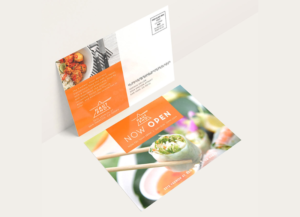
For the physical piece, postcard printing should match the amount of information the campaign needs. A simple HVAC tune-up offer may work with a compact layout. A remodeler showing before-and-after work may need more room for photography, proof, financing information, and service details.
Postcard advertising needs disciplined hierarchy. The front earns attention, while the back makes the next step obvious. Packing several services and offers onto one card usually weakens the message.
That matters in marketing postcard printing because space is limited. Every element should support the same response goal.
EDDM For Broad Neighborhood Coverage
Every Door Direct Mail works well when most homes on a selected carrier route are reasonable prospects. According to USPS, EDDM Retail requires at least 200 pieces and allows up to 5,000 pieces per day per ZIP Code.
For services with broad household demand, every door direct mail services can support route-based coverage without requiring a traditional named mailing list.
This form of direct mail marketing fits home services with broad neighborhood demand, including HVAC, roofing, cleaning, lawn care, and pest control.
Targeted Lists For More Selective Audiences
Broad coverage is wasteful when the service fits only a narrow audience. A premium remodeler may care about homeownership and property characteristics. A commercial cleaning company may need businesses of a certain type or size.
In those cases, a targeted mailing list can narrow delivery by geography, consumer characteristics, or business attributes. Business postcard marketing becomes more efficient when audience selection happens before design. The offer can then speak to a defined prospect instead of everyone at once.
Full Campaign Cost Matters More Than Print Price
Comparing the unit price of a hand-delivered piece with the unit price of postcard printing services does not show the true cost of either campaign.
Hand distribution carries labor, route planning, and transportation costs. Mailing adds postage, list preparation, addressing, and mail-entry work. Direct mail printing may cost more on paper while saving staff time in the field.
Cost per qualified lead = total campaign cost ÷ qualified leads
Cost per booked job = total campaign cost ÷ booked jobs
A contractor may find custom door hangers economical within a two-street radius but inefficient across ten neighborhoods. The same company may find mailed postcards easier to scale even after postage is included.
Tracking Turns Print Distribution Into Usable Data
Door hanger advertising can use a neighborhood-specific QR code, dedicated landing page, offer code, or tracked phone number. Postcard advertising can use the same tools while also separating lists, routes, and campaign drops.
The landing experience matters too. An AC tune-up mailer should lead to that service, not a generic homepage. The response path should continue the same message.
For campaigns that need narrower prospect selection, targeted direct mail can combine audience filters with trackable campaign elements.
Good direct mail services make it easier to compare neighborhoods, offers, and customer groups. Those results should shape the next campaign.
Combined Campaigns Build Recognition Across The Same Neighborhood
A home-service company can begin with postcard marketing across a selected area, then use business door hanger printing around jobs booked there. The mailbox creates the first touch, while visible work creates the second.
Keep the visual identity consistent, but give the second piece something new to say. A nearby project or seasonal deadline gives the follow-up a purpose. In marketing postcard printing, that continuity helps the pieces feel related without making the follow-up look copied.
A second set of direct mail postcards can reach households that missed the first offer, creating a simple sequence instead of relying on one exposure. For repeat drops, direct mail printing can stay consistent while the audience or offer is tested.
Frequently Asked Questions
Are Door Hangers Better Than Postcards For Contractors?
Door hangers fit active jobs and compact neighborhoods. Postcards scale more easily across larger service areas, customer lists, or selected carrier routes.
Is EDDM Better Than A Targeted Mailing List?
EDDM fits broad neighborhood saturation. A targeted list works better when homeowner status, income range, business type, or another qualification matters.
What Should A Local Service Postcard Include?
Keep the message centered on one service or closely related offer. Add useful proof, contact information, and one primary response action. Good postcard printing services should support that hierarchy rather than crowd it.
What Makes A Door Hanger Effective?
An effective piece is easy to understand at a glance. A clear headline, legible contact information, visible response method, and clean space around the cut area all matter.
How Should Direct Mail Campaigns Be Measured?
Track total cost, delivered pieces, responses, qualified leads, booked jobs, and revenue. Compare campaigns by cost per qualified lead and cost per booked job.
Conclusion
A door hanger earns its value through proximity. A postcard earns its value through controlled reach. That distinction is central to local service marketing. The stronger choice depends on where the audience lives, how narrowly it needs to be selected, how often the campaign will run, and what it costs to reach a qualified household.
Before production begins, define the service area, choose the audience, settle on one response goal, and decide how results will be tracked. Those decisions should come before paper stock, coating, or quantity.
For a campaign that needs printing, audience targeting, EDDM, or coordinated mailing support, MailProsUSA can help turn the plan into a campaign built around the neighborhoods or customer groups that matter most.