
A mailing budget looks straightforward until postage, address work, finishing, and postal preparation are added. In 2026, price the project from the mailbox backward: define the audience and mailing method first, then choose size, stock, quantity, and production setup.
Direct mail cost is more useful as a delivered cost per piece than as a print-only number. A low production quote can still become expensive if list processing, presort work, or postage are excluded.
Direct Mail Printing Cost in 2026: What You Actually Pay
The final price of direct mail printing comes from production, postage, data, and mail preparation. These costs interact. Heavier stock can raise production expense, a larger size can change postal category, and poor address data wastes both printing and postage.
USPS Notice 123, effective July 12, 2026, lists EDDM Retail postage at $0.260 for a qualifying flat up to 3.3 ounces. A retail First-Class Mail postcard is $0.65 and a stamped 1-ounce letter is $0.82. These are postage rates only.
Printing and Finishing
Production covers paper or cardstock, color, size, coating, cutting, folding, variable data, perforation, tabs, and quantity. A basic postcard usually needs fewer finishing steps than a folded self-mailer or an envelope package.
Stock should be chosen with mailing rules in mind because thickness, rigidity, coating, and finished dimensions can affect eligibility. Review standard postcard formats and stock choices before approving artwork.
Postage and preparation
Postage can become the largest line item in a direct mail campaign. EDDM may suit broad neighborhood coverage, while targeted mail is stronger when recipients must match specific criteria.
Preparation can include CASS processing, NCOA updates, deduplication, barcoding, presorting, and USPS entry. A direct mail printing company should show which of those steps are included instead of presenting one unexplained total.
Mailing data
List quality deserves the same attention as paper quality. An outdated address uses production and postage without creating useful reach.
That is why address hygiene belongs in direct mail pricing. Clean the data before the final quantity is approved. The cost problem is explained more fully in this guide to how weak new-mover data wastes the mailing budget.
Quantity Changes More Than the Print Price
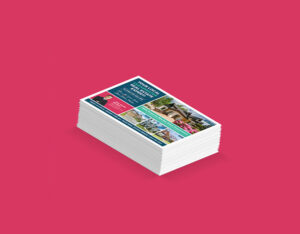
Bulk printing generally lowers production cost per piece because setup costs are spread across more units. The risk is overbuying. A cheap 20,000-piece run stops being economical if half the pieces become outdated.
Test runs protect the budget
A 500 to 2,500-piece run can make sense while the offer, creative, list source, or service area is still being tested. The unit price may be higher, but the business learns what deserves a larger investment before scaling direct mail printing.
For a first direct mail marketing test, measure response by audience and offer. That information can be worth more than a small production discount.
Larger runs need a schedule
Runs of 5,000, 10,000, or more can gain production efficiencies. Before ordering, check offer expiration, seasonality, storage, and mailing pace.
When comparing direct mail printing USA quotes, request several quantity tiers with the same stock, coating, dimensions, and mailing assumptions. That exposes the real breakpoints instead of making a decision from one bulk number.
Mailer Format Has a Direct Effect on Cost
Format affects print expense, finishing, postal classification, and how much information fits comfortably. In print marketing, more paper is not automatically more persuasive.
Standard postcards
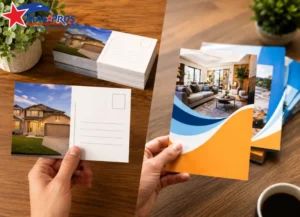
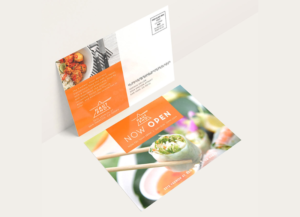
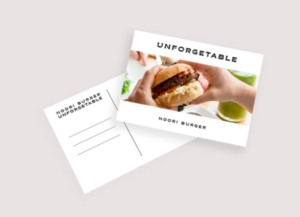
Postcards suit one clear offer, a proof point, and a direct call to action. Home services, dental offices, real estate, retail, and local events often fit this format.
Postcard printing services should be compared using the same finished specification. A 4 x 6 card and an oversized mailer may both be called postcards, but they can have different postal treatment.
EDDM mailers
EDDM is useful when geography defines the audience better than a named list. Restaurants, roofers, landscapers, and neighborhood retailers may benefit from selected carrier routes.
Before designing a larger route mailer, review EDDM postcard sizes and production choices. This is where direct mail printing and postal planning need to happen together, because a format that looks economical on the press can become expensive if it misses the intended postal category.
Flyers and folded pieces
Flyers provide room for menus, service lists, schedules, and detailed offers. Decide whether they will be handed out or mailed before building the file.
If the campaign needs more space than a postcard, available flyer formats can help with the size decision. A mailed flyer should be priced only after final dimensions, folds, weight, and mailing method are known.
Where Mailing Budgets Commonly Lose Money
Many costly mistakes are created before production starts. File, data, and quote review can prevent most of them.
Designing before postal review
Postal dimensions, address placement, folds, tabs, thickness, and machinability should be checked during design. A correction at the proof stage may cost nothing. After 10,000 pieces are produced, the same issue can mean rework or a costlier mail class.
Mailing bad records
Duplicates, old addresses, out-of-area households, and records that do not match the offer weaken the economics of direct mail marketing. Better targeting does not always require a more expensive list. It requires fewer paid pieces going to people who cannot realistically buy.
Comparing incomplete quotes
Two estimates are comparable only when quantity, size, stock, finishing, data work, postal preparation, and postage assumptions match.
Commercial printing prices can look attractive when mailing labor sits outside the headline number. Ask for delivered cost per piece and a list of exclusions. A second direct mail printing company should price the same job, not a stripped-down version of it.
Calculate the Campaign From the Mailbox Back
A useful budgeting formula is simple:
Total campaign cost = printing + postage + data + preparation + creative
Delivered cost per piece = total campaign cost ÷ pieces mailed
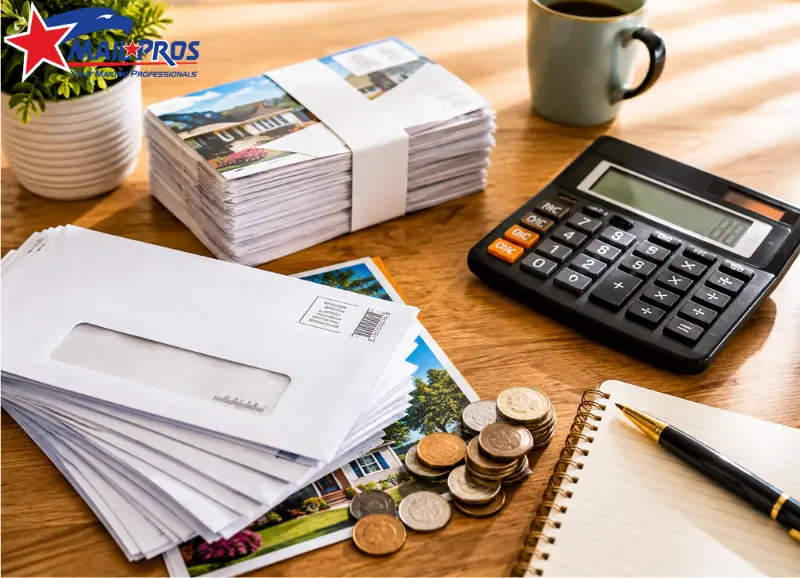
Consider a hypothetical 5,000-piece mailing with $950 in production, $2,000 in postage, $250 in data, and $350 in preparation. Total spend is $3,550, or $0.71 per piece. This is not a market quote. It shows why the direct mail cost should be calculated after all required direct mail printing expenses are included.
Measure cost per result
If that mailing produces 60 qualified responses, the cost per response is about $59. If 18 become customers, acquisition cost is about $197. Those numbers connect spending to an outcome, which a press price alone cannot do.
USPS Delivers summarizes the principle well: “Measuring direct mail effectiveness is crucial for shaping future campaigns.”
For print marketing, use QR codes, campaign URLs, dedicated phone numbers, offer codes, or CRM matchback. Keep the measurement method consistent across campaigns.
Tie the quote to delivery timing
Production turnaround is not an in-home date. Address processing, sorting, transportation, and USPS delivery still follow printing.
A strong direct mail printing USA estimate should identify artwork deadline, production completion, USPS entry, and expected delivery window. That makes the estimate easier to judge because the price is tied to the campaign’s arrival date.
Frequently Asked Questions
How much does it cost to mail 1,000 postcards in 2026?
There is no single all-in price because size, stock, data, mail class, and preparation vary. At the July 12, 2026 USPS rates, postage alone is $650 for 1,000 retail First-Class postcards. A qualifying 1,000-piece EDDM Retail mailing would carry $260 in postage. Printing and preparation are additional.
Is EDDM cheaper than a targeted direct mail campaign?
EDDM often costs less when broad carrier-route coverage is the goal. Targeted mail can cost more per address but may spend the budget more efficiently when only a narrow audience is relevant.
Does ordering more pieces always reduce direct mail pricing?
Higher quantities usually lower production cost per piece, but total spending rises. The best quantity is the amount that can be used while the offer, pricing, and audience remain current.
What should postcard printing services include in a quote?
A complete quote should identify size, stock, coating, quantity, production, finishing, address processing, postal preparation, postage assumptions, and delivery timing. Exclusions should be stated before approval.
How does bulk printing affect the overall budget?
Higher-volume production can reduce press cost per unit, but postage and data do not fall at the same rate. Compare the savings with storage, mailing frequency, and the risk of outdated creative.
Plan the Full Cost Before You Print
The strongest direct mail printing budget is built around the finished mailing, not the lowest press price. Confirm the audience, clean the data, select the postal path, approve a compliant format, and compare equivalent quotes. That gives commercial printing decisions a clear business purpose.
For a campaign-specific estimate, send the quantity, finished size, target area, mailing method, and desired in-home window to MailPros USA. A complete quote should make production, preparation, postage, and delivery assumptions clear before money is committed.