
A campaign can waste money long before a piece reaches the press. It usually happens when the team picks a mailing count first and tries to invent enough messages to fill it later.
A better plan starts with the voter universe, the calendar, and the work each piece needs to do. For many local races, three to six political mailers can be a useful planning range. That is a framework, not a rule. A short political campaign may need fewer pieces, while a longer race can justify more when each drop carries a different purpose.
Political Mailers And The Campaign Calendar
The first mailing should not be scheduled simply because the campaign has launched. It should arrive when voters have a reason to notice it, and later pieces should move with the voting window.
That matters in vote-by-mail states. In Orange County, the Registrar of Voters says vote-by-mail ballots for the November 3, 2026 General Election begin going to voters no later than October 5. A plan for political mailing in Orange County therefore has to account for October voting activity, not only Election Day.
The practical work happens backward from those dates. Artwork needs approval. The voter file has to be ready. Printing, addressing, presort, and postal entry all need room. Political mailers that look well timed on a calendar can become late if those steps are ignored.
Once those dates are mapped, keeping design, printing, addressing, and postal preparation together through political campaign mailing services can make the handoff from approved artwork to finished mail much easier to manage.
A Clear Purpose For Every Mail Drop
The easiest way to overspend is to send the same idea four times with a new headline and photograph.
Political mailers should move the story forward. An opening piece can establish the candidate and office. A later piece can deal with one issue. Another can add a qualification, endorsement, or documented record. Near the voting window, the focus can shift to accurate voting information.
That sequence makes direct mail frequency easier to defend. Instead of asking how many pieces to send, the campaign can ask how many different messages are worth paying to put in a mailbox.
This also improves political direct mail marketing. Repetition still has a role, but it works better when the visual identity stays familiar while the information changes. The same principle helps political advertising across digital, field, and print channels.
Budgeting The Full Mail Sequence
If the approved universe contains 15,000 households, four full drops mean 60,000 pieces. Add a fifth and the job becomes 75,000 before any smaller segment is included.
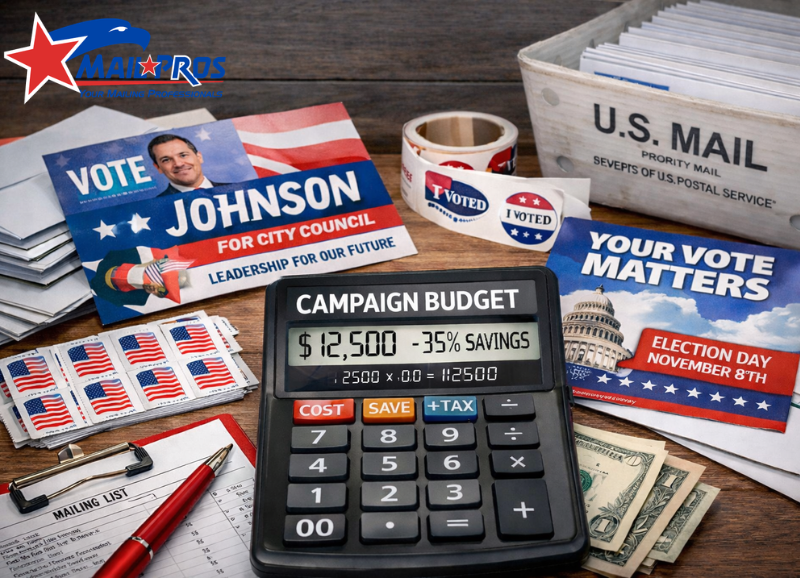
Political mailer printing is only one part of the cost. Postage, list work, address processing, and mail preparation also belong in the estimate.
The format should be settled with the message in mind. Postcard printing can work well for a short introduction, one-issue piece, or voting reminder because the reader can understand the point quickly. Political postcard printing becomes less useful when the campaign has to shrink the type simply to fit another paragraph.
A political direct mail company should be able to explain the cost of the full handoff, not only the press run. That gives direct mail campaigns a more realistic budget before the design is locked.
Voter List Quality Before Higher Frequency
More frequency cannot repair a poor list.
Before another drop is added, check duplicate records, address quality, household overlap, and district geography. Voter targeting should determine who actually belongs in the mailing universe before creative quantities are final.
This is especially important for political mailing in Orange County. ZIP codes and political boundaries do not always line up, so the campaign should work from the correct district and voter data rather than using a postal area as a substitute.
List cleanup belongs here, before print quantities are fixed. A targeted mailing list can help narrow the file to the intended geography and audience instead of paying to print pieces that never needed to go out.
Good voter targeting can also keep later campaign mailers focused on the people for whom that message was intended. Better data improves voter outreach in a practical way. It reduces wasted pieces, gives the budget a firmer quantity, and makes direct mail frequency easier to plan.
Mail Format And Message Length
Political postcards work best when the message is short enough to scan without crowding both sides. A simple introduction may fit comfortably on a postcard. A message that needs context or supporting detail may need another format. Political postcard printing can look economical at the quote stage, then become awkward when the campaign tries to fit a letter-sized message onto a card.
The warning signs are easy to spot. Type gets smaller. Several callouts compete for attention. The disclaimer gets pushed into whatever space remains. Nothing has enough room to stand out.
Political direct mail works better when the format follows the communication job. Political direct mail marketing benefits from the same discipline because format, copy, and timing reinforce one another instead of being decided separately.
Production Deadlines In The Final Weeks
Late changes are normal. A photograph gets replaced. A date needs correction. The voter file changes. Compliance language comes back with an edit.
That is why the schedule needs more than a mail date.
Set a proof deadline, a list-freeze date, and a target for postal entry before political mailers reach final design. Those three dates give the campaign and printer a working production window rather than a vague instruction to get the piece out sometime that week.
A final proof deserves more than a quick visual check. Read it at actual size. Check the candidate name, office, voting dates, address block, disclosure text, QR codes if used, and the mailing panel.
Political mailer printing becomes expensive to correct once thousands of pieces are already produced.
For larger quantities, addressing, presort, and USPS preparation need to remain on the same production schedule. A political direct mail company should be able to show where those steps fall before the drop date is approved.
Compliance Before Printing
Disclosure review should not be left for the final PDF.
For federal campaigns, the Federal Election Commission defines a mass mailing as more than 500 substantially similar pieces within 30 days. Covered public communications can require clear and conspicuous disclaimers.
California also treats mass mailings as campaign advertisements under FPPC guidance.
The campaign should have the appropriate treasurer, counsel, or compliance professional approve the disclosure before production. That step matters for political advertising in any format.
A correction made while reviewing a proof costs time. A correction discovered after thousands of pieces have been printed creates an entirely different problem.
A Practical Four-Drop Sequence
A four-piece structure is useful because it forces each mailing to carry a different assignment. It is not a required number. It simply shows what a sequence can look like when every piece contributes something new.
Candidate Introduction
The first piece should make it easy to identify the candidate, office, relevant background, and central theme.
It does not need to reproduce the campaign website. The reader should be able to understand the main point within a few seconds.
Issue Focus
The next mailing can concentrate on one subject that matters to the political campaign.
Political postcards work particularly well here when one idea can be explained cleanly. Once several unrelated issues are squeezed onto the same card, the hierarchy usually disappears.
Credibility And Record
The third piece can introduce something the earlier mail has not covered. That may be a documented qualification, endorsement, record, or another verifiable point.
This is where political direct mail can add depth rather than simply repeat name recognition.
Voting Reminder
The final political mailers should make the next step easy to understand.
Confirm dates with the relevant election authority before release, then leave enough time for printing and postal entry. A reminder that reaches the mailbox after its useful window has passed cannot be rescued by stronger design.
A smaller political campaign may combine two of these functions. Larger direct mail campaigns may separate them further. The useful test is whether the next piece adds information rather than simply adding volume.
Frequently Asked Questions
How Many Political Mailers Should A Local Campaign Send?
Three to six political mailers can be a practical starting range for many local races. The final count should come from the voter universe, voting calendar, budget, and number of distinct messages the campaign can support.
How Far Apart Should Campaign Mailers Be?
There is no universal spacing rule. Campaign mailers should be timed around the voting calendar, production requirements, and purpose of each piece rather than a fixed weekly formula.
Are Political Postcards Better Than Letters?
Political postcards are useful for short, scannable messages. Letters provide more space when the subject needs explanation. The format should follow the amount of information the voter actually needs.
Should Every Voter Receive Every Mailing?
Not necessarily. Voter targeting can separate broad voter outreach from messages intended for a more specific lawful audience segment.
When Should A Campaign Finalize Its Mailing Schedule?
Finalize the schedule early enough to protect list preparation, proof approval, political mailer printing, compliance review, and postal entry.
Final Thoughts
The right number of political mailers is not the highest number the budget can tolerate. It is the number of useful messages the campaign can produce, target, approve, and mail on time.
Start with the voting dates. Confirm the voter universe. Price the entire sequence. Then decide whether each additional piece earns its place.
For teams ready to turn that plan into quantities, formats, and mail dates, MailProsUSA can coordinate printing, list processing, addressing, and mailing. Request the quote with the actual voter count, format, and number of drops so the campaign can evaluate the complete mailing plan rather than estimating one piece at a time.