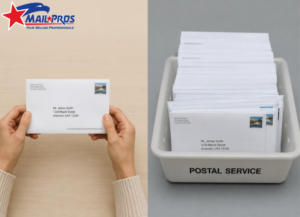


Direct mail can become expensive long before a postcard reaches a mailbox. Poor address data, broad targeting, repeated manual setup, weak timing, and incomplete attribution all eat into a campaign’s budget. Direct mail automation reduces those losses by connecting audience data, campaign rules, production, and response tracking.
USPS reports that 40% of marketers use a technology platform to execute direct mail campaigns, and 81% of those users say it delivers their best response rate. Software does not guarantee performance. Better systems remove preventable waste and give marketers cleaner information for the next decision.
Start With the Economics, Not the Platform
A campaign should have a financial baseline before any workflow is automated. Direct mail ROI is better judged from attributed profit or contribution margin than from scans, impressions, or raw revenue.
ROI = (Attributed profit – total campaign cost) / total campaign cost × 100
Total campaign cost should include list acquisition, data processing, design, printing, postage, platform fees, and internal labor. Direct mail automation helps by keeping the process consistent enough to compare results over time. Before changing the creative, first inspect the data. The guide to common direct mail targeting mistakes covers problems such as stale addresses, broad audience selection, and poor timing that can distort results before the offer is even tested.
Mailing Fewer People Can Produce a Better Return

Mailing volume is not a profit metric. A smaller, better-qualified list can outperform a larger file filled with weak records.
Direct mail marketing automation can apply suppression rules before production. An HVAC company, for example, can remove customers who have already booked, exclude ZIP Codes outside its service area, and separate recent estimate requests from households with no known buying signal.
That filtering can improve direct mail response rate because a greater share of the budget reaches people who have a realistic reason to act. A targeted mailing list can use geography, household characteristics, demographics, or business criteria.
Trigger Mail When Customer Intent Is Stronger
Direct mail automation becomes more valuable when a send is tied to a meaningful event instead of a fixed calendar date.
Consider a homeowner who requested a roof estimate but did not schedule the job. A follow-up postcard seven to ten days later has a clear business reason behind it. The company already knows the service requested, the property location, and the approximate stage of the buying process. That is a stronger trigger than mailing every person who viewed a roofing page.
The same principle works for a dental practice with inactive patients or a dealership approaching a service interval. Automated direct mail services can run these rules without rebuilding the mailing file every week.
Personalization Has to Change Something That Matters
Adding a first name is the simplest form of direct mail personalization, but it does little if every recipient still receives the same offer.
Useful personalization changes the service, proof point, offer, image, or call to action. A former roofing customer due for gutter service should not receive the same message as a homeowner who requested a roof estimate yesterday.
A capable direct mail service provider can use variable fields while keeping the production template controlled. Customized direct mail is especially useful when several audience segments need different offers without turning every version into a separate production job.
Attribution Is Where the Real ROI Picture Appears
Direct mail advertising is often under-credited. A recipient may see a postcard, then search for the company or call from a business listing. If reporting counts only QR scans, the campaign may look weaker than it was.
Direct mail automation should connect several response signals, including unique QR Codes, personalized URLs, campaign-specific phone numbers, offer codes, CRM source fields, and post-campaign match-back analysis.
USPS notes that marketers using automation commonly track QR Codes, personalized URLs, customer activity within defined time periods, and orders for featured products or services. An automotive chief strategy officer quoted in USPS research described the goal simply: “There’s a dedicated QR Code and phone number that go into the customer CRM.”
The direct mail strategy should define those paths before artwork is approved. Tracking added after production cannot recover information that the original mailpiece never captured.
A Simple ROI Example Shows Why More Volume Can Mislead
Assume a company mails 10,000 postcards for an all-in cost of $7,500. It gains 46 customers, with an average contribution margin of $420 from the first completed job.
46 × $420 = $19,320 attributed contribution
($19,320 – $7,500) / $7,500 × 100 = 157.6% ROI
Now assume direct mail marketing automation removes weak records. The next mailing drops to 8,500 pieces, costs $6,500, and produces 43 customers.
43 × $420 = $18,060 attributed contribution
($18,060 – $6,500) / $6,500 × 100 = 177.8% ROI
The second campaign produces fewer customers but better economics. That is why direct mail ROI should not be judged by response volume alone.
Test the Variable Most Likely to Change Profit
A useful test answers one question. If the audience, offer, format, headline, and landing page all change together, a winning version may emerge, but the team will not know what caused the improvement.
Start with the factor carrying the largest financial risk. In direct mail automation, disciplined testing matters because repeatable workflows make comparisons more useful. If audience quality is uncertain, compare two segments with the same offer. If the audience is proven, test the offer next.
A direct mail service provider should preserve test groups, versions, mailing dates, and response data so results can be compared without guesswork. The direct mail retargeting guide is useful when planning follow-up audiences because recent behavior and updated records should affect who receives the next piece.
Connect the Mailpiece to One Clear Next Step
Direct mail automation works best when the recipient knows exactly what to do next. A mailpiece can lead to a quote form, appointment page, store offer, renewal page, or phone line, but the destination should match the promise made in print.
USPS campaign analysis shows how QR Codes can connect physical mail to trackable digital destinations and reports that adding direct mail to digital activity more than doubled overall revenue in its own campaigns. USPS also notes that these internal results are not typical of every campaign and vary by execution, budget, and industry.
Direct mail advertising does not become profitable merely because the workflow is automated. Audience quality, offer strength, sales follow-up, and cost control still determine whether response turns into revenue.
Businesses building a coordinated program can use direct mail marketing services to bring list preparation, production, mailing, and tracking into one campaign plan.
Automation Still Needs Human Controls
Automated direct mail services should include address validation, deduplication, suppression controls, segmentation, variable-data capability, proofing, campaign identifiers, and exportable reporting.
Just as important, someone needs authority to stop a send when inventory changes, an offer expires, a customer converts, or the source data is wrong. Direct mail automation can scale mistakes as efficiently as it scales a good process.
Track delivered quantity, conversions, acquisition cost, contribution margin, and customer value alongside direct mail response rate. Those measures give a direct mail strategy enough context to distinguish attention from profitable action.
What is direct mail automation?
It uses software and predefined rules to prepare, trigger, personalize, send, and measure physical mail with less manual work.
How can automation improve marketing ROI?
It can reduce wasted records, improve timing, cut repetitive work, and strengthen attribution. The financial benefit appears when those changes lower acquisition cost or increase profitable conversions.
What is a good response rate for direct mail?
There is no universal benchmark for every U.S. industry, audience, offer, and format. Judge response alongside conversion rate, margin, acquisition cost, and customer value.
Can direct mail campaigns be triggered from CRM data?
Yes. CRM events such as an unclosed estimate, renewal date, lapsed purchase, service interval, or customer-status change can start a mailing when the systems are connected correctly.
How does direct mail personalization improve a campaign?
It is most useful when it changes something relevant to the buying decision, such as the offer, service, location, customer stage, or call to action.
Conclusion
Better returns come from removing bad records before printing, mailing when buying intent is stronger, tracking several response paths, and testing one meaningful variable at a time. Direct mail automation gives those practices a repeatable structure, but clean data and sound campaign judgment still determine the outcome.
Choose one campaign and calculate its real acquisition cost. Find the largest leak, fix that problem first, and run a controlled comparison before increasing volume.
Businesses ready to turn that process into a measurable mailing program can work with MailProsUSA to move from audience preparation through production and tracking with a clear ROI target.