Political Mail STIDs: Making Campaign Mail Easier to Track

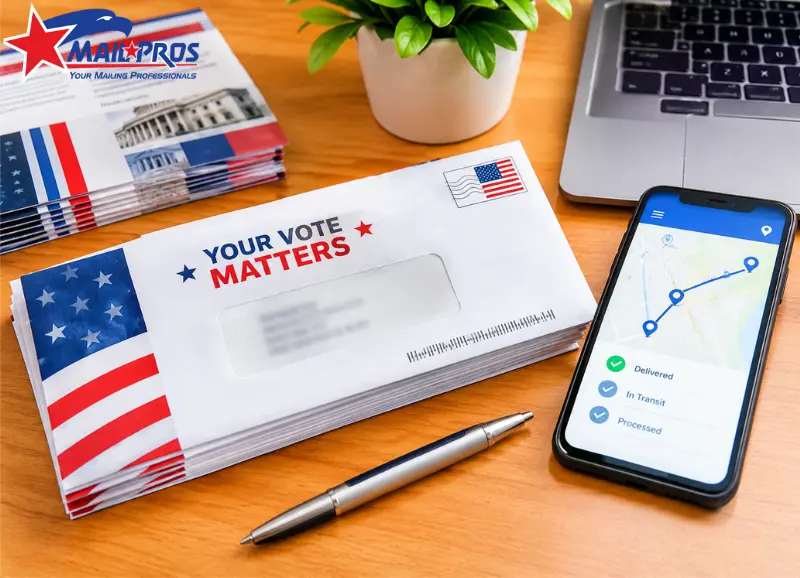
A mailer can be designed, approved, printed, and paid for right on schedule. Even so, campaigns that plan a careful timeline behind every mailer lose sight of the piece once USPS takes the trays.
For political mail sent in the last three weeks of a race, that blind spot gets expensive. Early ballots are already coming back, and canvassers need to know which streets have the piece. A three-digit code called a Service Type Identifier, or STID, lets the campaign see exactly that.
Political Mail STIDs Give Every Campaign Piece A Trackable Identity
A political STID is a three-digit number USPS reserves for campaign and advocacy mail. It sits inside the Intelligent Mail barcode (IMb), the strip of 65 bars printed on automation letters and flats. The code tells postal equipment the mail class, the address correction option, and whether tracking is on.
Unlike an ordinary STID, it also marks the piece as campaign mail, which helps plant staff find it. The scans still flow into the same reports a commercial mailer gets. PostalPro posted its newest STID fact sheet for ballot and campaign mail in October 2025. Code selection should start there, not with last cycle’s barcode file.
Confirm The Sender Qualifies
Not every sender may use these codes. USPS limits them to registered candidates, campaign and party committees, PACs, super PACs, and groups doing issue advocacy or voter mobilization. Official ballots carry their own ballot STIDs. Printing one of those on a candidate postcard sends postal staff the wrong signal.
Informed Visibility Turns Barcode Scans Into Delivery Reports
Those scans land in USPS Informed Visibility Mail Tracking and Reporting, or IV-MTR. The system logs an event, in near real time, each time a pallet, tray, or piece passes a reader.
Full-Service preparation makes the data far richer. It links every piece to its tray and every tray to its pallet, so one pallet scan at the dock updates thousands of pieces at once. Shops that offer bulk mailing services build these links during presort.
Access requires a USPS Business Customer Gateway account with Informed Visibility turned on. Some campaigns skip the login and take a feed from their mail provider instead. Others pay for political mail tracking solutions that turn the same scans into dashboards and alerts.
Read Scans In Sequence
Scans do not carry equal weight. An entry scan only proves USPS accepted the containers. Processing scans follow pieces through sorting machines and show how far each ZIP Code has moved. The one to watch is the final sort at the destination plant, because it puts the piece in carrier order.
Four Setup Steps Before Any Political Piece Goes In The Mail
Many tracking problems start before the press runs. A direct mail service Laguna Beach council candidates use for a few thousand pieces faces the same four checks as a national firm mailing a statewide measure.
Choose The Correct STID
The last choice decides what happens to undeliverable pieces. Electronic ACS notices are worth requesting, because each one flags a voter who moved. Lock the code into the print file well before political direct mail printing starts..
Register Codes In IV-MTR
Nothing on the printed piece shows this step, so it is easy to skip. PostalPro tells IV-MTR users to contact the IV-MTR Help Desk whenever they add or change STIDs. Political mail STIDs that were never registered still get scanned. The campaign just never sees that data.
Keep Serial Numbers Unique
Full-Service rules require each barcode to stay unique for 45 days. Reuse a serial range across two drops, and their scans blend together. Campaigns planning several waves, a choice covered in this guide on how many mailers a campaign should send, need a separate range for each wave.
Tag Every Container
Red Tag 57, Political Campaign Mailing, goes on every tray and pallet at entry. The 2026 Postal Bulletin adds a second requirement. Mailers must also check the Political Campaign Mailing box on the electronic postage statement, which USPS says helps with capacity planning and improves political mail visibility across its network.
Common Mistakes That Leave Political Campaign Mail Untracked

Gaps in USPS mail tracking reports often come from errors that are easy to prevent.
- A ballot STID placed on candidate mail
- A commercial barcode template reused for a campaign job
- Basic barcodes printed with repeated serial numbers
- Scan data left under the printer’s Mailer ID with no sharing set up
- New STIDs printed but never added to IV-MTR
Scan Data Helps Field Teams Time Doors And Calls
Direct mail campaign tracking proves its worth when it changes what volunteers do the next morning. The Postal Service’s 2026 Postal Bulletin puts the broader idea in one line.
Take a 12,000-piece persuasion mailer on public safety. By Tuesday night, that political mail has final sort scans in three precincts but none in a fourth. Canvassers work those three on Wednesday with the same message. Meanwhile, the phone bank holds the fourth until its scans arrive.
Build A Daily Drop Report
Good mail tracking and reporting does not need an expensive platform. A shared spreadsheet works if it lists each drop’s piece count, class, entry date, and in-home window. Teams using political direct mail services can ask the vendor to update it every morning. Two figures per precinct deserve the closest look. One is the share of pieces with a first processing scan, and the other is the share with a final sort scan.
Respond When Political Mail Runs Late
Direct mail tracking matters most when a drop runs late. First-Class Mail has a USPS service standard of 1 to 5 days, while USPS Marketing Mail takes longer. If a ZIP Code shows no final sort scans once its standard has passed, the mail provider should raise it with USPS that day. When delays repeat, move the next drop earlier.
A Short Checklist For Choosing A Political Direct Mail Vendor
These problems are cheapest to catch at the quoting stage. Get written answers to four questions before the first proof.
- Which STID will print on each piece, and who checks it before political direct mail printing begins?
- Who owns the Mailer ID, and how will scan data reach the campaign?
- Will the job go out as Full-Service?
- How often will reports arrive in the last 14 days?
Good political mail tracking solutions rest on exactly these setup choices. A national firm should answer all four on the first call, and so should any direct mail service Laguna Beach campaigns already use for local races.
Frequently Asked Questions
What Does STID Mean On USPS Mail?
STID stands for Service Type Identifier. These three digits follow the barcode identifier in the IMb. They decide how USPS Informed Visibility reports the piece and what happens if the address is undeliverable.
Does Campaign Mail Get Faster Delivery Than Other Mail?
No. Campaign pieces move at the service standard of the class paid for. Political STIDs and Tag 57 help staff find them in a plant, and USPS mail tracking then shows whether each drop met its standard.
What Is The Difference Between Election Mail And Political Mail?
Election Mail comes from election officials. It includes ballots, voter registration forms, and polling place notices. Campaign mail comes from candidates, parties, PACs, and advocacy groups. Ballots carry ballot STIDs, campaign pieces carry political STIDs, and other election office mail uses standard codes with an Election Mail marker.
What Is USPS Tag 57?
Tag 57 is the red container tag marked Political Campaign Mailing. It goes on trays and pallets at entry so postal staff can spot campaign mail at the container level. The STID does the same job for each piece.
How Can A Campaign Track Mailers After They Are Dropped?
Direct mail campaign tracking starts before the drop. Each piece needs a unique IMb with a political STID, and the job should be Full-Service. After that, the campaign needs IV-MTR access or a data feed from its mail provider.
To Sum Up
Without direct mail tracking, a field team works on guesses in the weeks when timing matters most. The fix is small. Print the correct STID, keep serial numbers unique, register new codes in IV-MTR, and plan follow-ups around final sort scans. Each step adds political mail visibility for USPS and for the campaign.
For political direct mail services that handle printing, postage, and tracked delivery as one job, contact MailProsUSA for a quote on the next drop. Send the voter file and target in-home dates to get a production schedule built backward from Election Day.