Consistent Print Materials Help Voters Remember Your Campaign

Consistent print materials come from one style sheet, one master file set, and one printer. Agree on the colors, typefaces, logo, photo, and name wording before the first order. Then check every new proof against the last three pieces you mailed.
Most households saw plenty of campaign paper and remembered very little of it. People sort the mail on the walk from the box to the kitchen, and in those few seconds they either recognize the sender or they do not.
Why Do Consistent Print Materials Decide What Voters Remember?
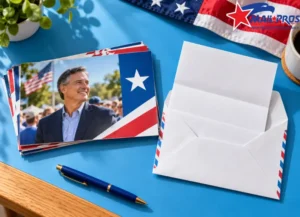
Name recognition is built on repetition, and repetition only works when the pieces look related. Six campaign postcards that share a blue, a typeface, and a photograph land as six reminders of the same candidate. Six that share none of them land as background noise.
The drift is rarely deliberate. A local race prints yard signs in spring, a door hanger in summer, and four mailers in the closing weeks, each one designed by whoever was free that month. By October the candidate has three blues, two logo files and photos from two sittings. That is the most common problem we see when a campaign moves to a single printer mid-cycle.
Our guide to political direct mail for local elections covers the list work and the drop schedule. Political marketing at this level rewards sameness far more than fresh ideas.
Settle the Style Sheet Before Any Political Campaign Materials Go to Press
No volunteer will read a thirty-page brand book. A single page taped above the desk does get used, and every batch of print materials is checked against it.
Lock the Campaign Colors in CMYK and Pantone
Write down the CMYK build, the Pantone number, and the hex code for each campaign color. Screens display RGB and presses print CMYK, so a blue that looks right on a laptop can arrive closer to purple on paper.
Choose Two Typefaces and Record Their Sizes
One typeface for headlines and one for body copy covers signs, mailers, and political flyers. Record the point sizes too. A third font appears the moment somebody builds a handout on a phone.
Approve One Logo File and One Photo Session
Approve one logo file, plus a one-color version for signage and a reversed version for dark backgrounds. Photograph the candidate once, in one outfit, so voters meet the same person across all print materials.
Write the Candidate Name the Same Way Every Time
Fix the name form, the office, and the slogan, then leave all three alone. “Maria Ruiz for Council” and “Ruiz for City Council” ask a voter to remember two people. Send the finished page to every vendor handling political campaign printing.
Give the Name and the Call to Action a Fixed Position
Position does as much recognition work as color. When the candidate name sits bottom right on one mailer and across the top of the next, the reader has to hunt for it. Hunting is usually the moment a piece goes into the recycling, so lock three zones for the whole cycle.
- The name and office in the same corner, at the same relative size, on all print materials
- The slogan in one position, never moved to fit a tight layout
- One call to action in the same place, worded the same way, whether the ask is to vote, donate, or attend
That discipline pays off most on political postcards, which get about two seconds to prove who sent them. Build the zones into a reusable template before your next political postcard printing run, and the template carries the campaign through every later wave.
Build the Legal Disclaimer Into Every Layout
The Federal Election Commission requires the “paid for by” disclaimer on printed communications to sit inside a printed box, set apart from the rest of the piece. Black type at 12-point on a white background is one accepted way to meet the readability standard on pieces no larger than 24 by 36 inches.
A package does not share one disclaimer, and that is the detail campaigns miss. Anything needing a box on its own still needs one inside the envelope, so a poster sent with a fundraising letter carries its own.
Draw that box into the master template and keep it in the same corner across all print materials. Whoever provides your political printing services should be checking for it too. State rules sit on top of the federal ones, so confirm the wording with counsel.
Make the Mailbox and the Inbox Show the Same Design
Informed Delivery is a free USPS service that emails subscribers a grayscale preview of the mail arriving that day. The mailer can attach a full-color image beside it. USPS counted 78.7 million active users across 53.9 million households in its Year in Review for April 2025 through March 2026. Its design rule is plain.
“Sync the design of the ride-along image with the mail piece”
When the preview shows one color scheme and the envelope shows another, your campaign direct mail has bought two impressions and built two memories. Our walkthrough of USPS Informed Delivery covers the setup. Political advertising only compounds when the printed and digital versions of your print materials agree.
Print in Waves From a Single Master File Set
The look is settled by design. It is kept by file discipline, which the team running your political printing services should own.
Keep One Approved Folder and Name Every File
Most reprints go wrong because somebody pulls an old attachment from an email thread and the October mailer goes to press in the September blue. Keep one folder of approved production files, name each with the piece, the version number and the date, and delete nothing.
Ask for a Printed Proof on the Real Paper Stock
Paper changes the way ink behaves. One file will not match on a coated postcard and an uncoated door hanger unless the printer adjusts for the stock, which is how three low-bid suppliers produce three different blues. Ask for a proof on the actual stock before any political flyer printing run, then keep it as the color reference for later batches of political campaign materials.
Run a Ten Minute Check Before You Approve a Proof
Lay the last three print materials on a table beside the new proof and compare four things.
- The blue and the red, measured against the style sheet rather than judged by eye
- The logo file and the headshot, at the same proportions and the same crop
- The candidate name, in the same position and at the same relative size
- The disclaimer box, the website and the phone number, readable at arm’s length
Ten minutes of comparison costs far less than a reprint. Campaigns that skip it find the problem once 20,000 mailers are in the mail stream. That is the argument for running political mail marketing as one job, and for ordering yard signs, banners, and political posters from the same shop.
Frequently Asked Questions
How Many Printed Pieces Does a Local Campaign Need?
Four formats carry most municipal and county races. Yard signs, door hangers, one or two mailers, and an event handout. Three touches to the right households beat one touch to three times as many. Campaign postcards buy that frequency cheaply, and political postcard printing adds a late wave.
Does Consistent Design Really Improve Response Rates?
The ANA Response Rate Report from July 2025 puts direct mail response at 4.4 percent on average and 5 to 9 percent on house lists. Recognition moves a voter file toward the upper end. Consistent print materials earn that recognition in campaign direct mail, and template-driven political flyer printing keeps it.
Should Yard Signs and Mailers Use the Same Design?
They should use the same system, not the same layout. A yard sign is read at 35 miles an hour and needs the name and the office. A mailer can carry issues and endorsements. Political postcards sit closer to the sign, which is why strong political direct mail starts there.
How Far Ahead Should Campaign Printing Be Ordered?
Build the templates 10 to 12 weeks before the first drop and order at least three weeks before the in-home date. Political campaign printing capacity tightens in the closing month, when political mail marketing volume peaks for every race at once.
Can a Campaign Change Its Look Mid-Race?
Only when the current identity is clearly failing, and only once. A redesign resets voter recognition to zero and discards every impression already bought. Rewriting a weak message is cheaper and protects the political advertising money already spent on political posters and signs.
Wrapping It UP
Consistency is the least glamorous job in political marketing, and it decides whether six impressions feel like six or like one. Settle the style sheet, box the disclaimer, keep a single master file set, match the mailed piece to the digital preview, and check every proof against the last three.
Send your piece list, quantities, and drop dates to MailProsUSA. You will get one schedule covering design, printing, and mailing, from political flyers and yard signs through to the full run of print materials your campaign needs.