Is Direct Mail Marketing Effective? What Determines Real ROI

Direct mail earns its budget when it produces profitable customer action. A polished postcard sent to weak addresses is expensive paper. A relevant offer sent to a qualified audience, however, can generate trackable calls, appointments, store visits, and online orders.
So, is direct mail marketing effective? Yes, but the physical format is not what guarantees success. Results depend on list accuracy, audience fit, offer strength, mailpiece design, timing, repetition, and response tracking. Businesses that connect these elements are better positioned to turn mailbox exposure into measurable revenue.
Where Physical Mail Has an Advantage?
A mailpiece must be physically handled before it is saved, shared, or discarded. That brief interaction allows a company to present its name, offer, deadline, and response method without competing with pop-ups or scrolling content.
Research published by the U.S. Postal Service found that physical advertising created stronger memories than comparable digital advertising. The research also found this effect across age groups, which challenges the assumption that printed marketing appeals only to older consumers.
Direct mail can be particularly useful for businesses serving a defined area. Dental practices, automotive repair shops, restaurants, real estate professionals, home service companies, and local retailers can place timely offers in the homes most likely to need them.
Where Direct Mail Falls Short?
Direct mail becomes inefficient when it is used without a defined customer profile. Mailing every available address may increase reach, but it can also increase printing and postage costs without improving sales.
The channel is also unsuitable for offers that require instant changes. Once a piece has been printed and entered into the postal system, its price, deadline, and wording cannot be edited. Campaign details must therefore be verified before production.
Professional Direct Mail Marketing Services can reduce these risks by coordinating data preparation, design, printing, postal processing, and campaign scheduling.
What Separates Profitable Mail From Wasted Spend?
List Quality Comes Before Creative
The mailing list determines who receives the offer. Even excellent copy and premium printing cannot compensate for outdated addresses or poor audience selection.
Businesses should first decide whether the campaign requires broad geographic coverage or person-level targeting. A restaurant opening in a new neighborhood may want to reach most households within a short driving distance. A luxury remodeling company may need homeowners in selected property or income categories.
With targeted direct mail marketing, audiences can be selected using appropriate consumer or business criteria. These may include location, homeownership, property characteristics, industry, company size, or job title. Only criteria connected to the purchasing decision should be used.
Address preparation also matters. CASS-certified software helps standardize addresses against USPS data. NCOALink processing can identify address changes reported to USPS. Duplicate removal and suppression files provide additional protection against wasted pieces.
The Offer Must Carry the Campaign
A recipient needs a clear reason to respond. “Quality service at competitive prices” describes almost every business and provides little motivation.
A useful offer may provide:
- A specific discount or service credit
- A free inspection, estimate, or consultation
- Priority scheduling during a busy season
- A useful bonus with a qualifying purchase
- An exclusive package for a defined audience
- A deadline that creates legitimate urgency
The offer must also make financial sense. A large discount may produce responses while eliminating the profit needed to recover campaign costs. Before approving the creative, calculate the average gross profit from one new customer and determine how many customers the mailing must acquire to break even.
Choose the Right Mailing Approach
Postcards, Letters, and Self-Mailers
Postcards suit offers that can be understood quickly. They work well for openings, seasonal services, appointment reminders, retail promotions, and local lead generation because no envelope must be opened.
Letters provide more room for explanation. They may be more appropriate for financial services, nonprofit appeals, healthcare communication, professional services, and higher-value B2B offers.
Self-mailers and brochures help when customers need to compare several services or packages. More space is valuable only when the additional information supports a decision. Filling every panel with general brand copy can bury the offer.
The answer to “is direct mail marketing effective?” often depends on this format decision. The piece should match the complexity of the purchase rather than the personal preference of the business owner.
EDDM or a Targeted List
Every Door Direct Mail, commonly called EDDM, reaches eligible addresses along selected USPS carrier routes without requiring an individually named mailing list. It can support businesses whose potential customers are concentrated around a physical location or service area.
Targeted mailing is usually more appropriate when only certain households or companies qualify. A pool contractor, for example, may not benefit from reaching apartment renters. A commercial supplier may need purchasing managers rather than every company at an address.
Reviewing local mailing list strategies can help determine whether route coverage or list-level precision offers the better use of the budget.
Build the Mailpiece Around the Response
Design for a Five-Second Review
A recipient should not have to study the piece to discover its purpose. The first side of a postcard or the opening section of a letter should establish the offer immediately.
A practical visual order is:
- The primary benefit
- The offer
- A short explanation
- Proof or qualification details
- The call to action
- The deadline and required terms
Contact information should be easy to find, but several competing calls to action can create hesitation. Select one primary response method and keep any secondary option less prominent.
Typography must remain readable at the final printed size. Thin fonts, weak contrast, crowded margins, and text placed too close to trim or fold areas can damage an otherwise strong message. A printed proof often reveals problems that are less obvious on a monitor.
Make Personalization Useful
Adding a name does not automatically make a mailpiece relevant. Effective personalization changes information according to a genuine customer need.
A multi-location company can show the closest office. A retailer can vary the offer for current, inactive, and first-time customers. An automotive company can present different services according to vehicle category or previous service history, provided the data is accurate and used responsibly.
Modern customized direct mail can vary headlines, photographs, maps, offers, URLs, and QR destinations within the same production run. Personalization should make the decision easier, not make the recipient wonder how much information the sender possesses.
Connect the Mailbox to Measurable Action
Track More Than QR Code Scans
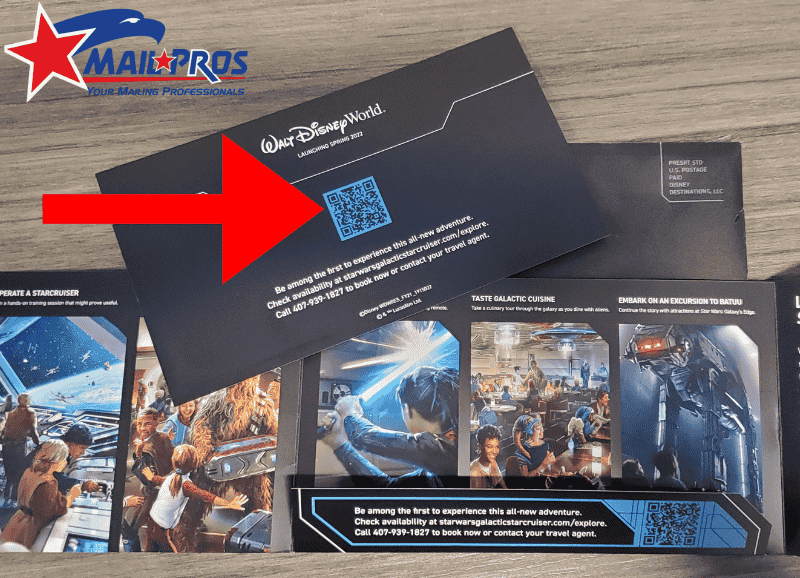
QR codes provide a quick route from print to a mobile page, but scans alone do not represent sales. A campaign can receive substantial traffic and still fail if the landing page is slow, confusing, or disconnected from the printed offer.
Useful tracking methods include:
- A dedicated landing page
- A campaign-specific telephone number
- A unique promotional code
- A personalized URL
- A reply card
- Source questions on booking forms
- Customer matchback analysis after the campaign
The landing page should repeat the printed offer and remove unnecessary navigation. If the mailpiece promotes an estimate, the QR code should open an estimate form rather than a general homepage.
Intelligent Mail barcode data may provide postal processing information, but it does not prove that a recipient read the piece. Delivery information and customer response data must be evaluated separately.
Calculate the Break-Even Point
Suppose a campaign costs $5,000 and each new customer produces $500 in gross profit. The campaign needs ten attributable customers to recover its direct cost. Responses that do not become customers cannot be counted as completed acquisitions.
Track these numbers:
- Pieces mailed
- Undeliverable pieces
- Responses
- Qualified leads
- Completed sales
- Cost per lead
- Cost per acquired customer
- Attributable gross profit
- Campaign return
General response-rate benchmarks can provide context, but a company’s own results are more useful. The ANA Response Rate Report shows why performance should be assessed by list type, format, objective, and audience rather than one universal percentage.
Improve Results Through Controlled Testing
Test One Meaningful Variable
A first mailing should produce information as well as leads. Divide a qualified audience into comparable groups and change one major element, such as the headline, offer, format, or response method.
Changing the list, creative, offer, and landing page at the same time makes the results difficult to interpret. The stronger version should become the control for the next test.
Record the audience rules, quantity, in-home period, creative version, offer, leads, customers, and gross profit. This campaign history becomes a business-specific benchmark instead of relying entirely on industry averages.
Let the Buying Cycle Set Frequency
One mailing may generate immediate orders for a restaurant or seasonal service. It may take longer to influence a commercial buyer, homeowner, patient, or donor.
Repetition should support the expected decision period. It should not mean sending the same piece indefinitely. Follow-up versions can answer a common objection, introduce proof, clarify the offer, or provide a final deadline.
Businesses planning direct mail for business growth should establish the testing period, follow-up schedule, and stop conditions before the first mailing enters production.
Frequently Asked Questions
Is Direct Mail Marketing Effective for Small Businesses?
Yes. It is most effective when a small business has a defined service area, a qualified audience, a profitable offer, and a reliable tracking method. Starting with a controlled local test limits risk and provides data for the next mailing.
What Is a Good Direct Mail Response Rate?
There is no single response rate that applies to every campaign. Results vary by industry, list type, offer, format, brand familiarity, and customer value. Cost per acquired customer and gross profit provide a more meaningful evaluation than response rate alone.
How Many Times Should Direct Mail Be Sent?
Frequency should reflect the buying cycle, season, offer deadline, and previous campaign results. Local promotions may need a short sequence, while higher-value services may require several spaced contacts. Each follow-up should have a defined purpose.
Is Direct Mail Better Than Email?
The channels perform different jobs. Email is fast and inexpensive to distribute, while physical mail provides a tangible touchpoint. Coordinating both channels can reinforce the same offer and give customers more than one way to respond.
How Is Direct Mail ROI Calculated?
Subtract the full campaign cost from attributable gross profit, divide the result by the campaign cost, and multiply by 100. Include data, design, printing, postage, tracking, and campaign-management expenses in the total cost.
Conclusion
Is direct mail marketing effective? It can be, but profitability comes from disciplined execution—not mailing volume alone. A clean list, relevant offer, suitable format, accurate postal preparation, and reliable attribution give the campaign a fair chance to succeed.
Prepare five details before requesting pricing: the campaign goal, target area, approximate quantity, offer, and preferred in-home date. Then contact MailProsUSA for a campaign review and custom quote. Start with a controlled mailing, measure completed sales, and use the evidence to improve the next drop.