Your nationwide partner for printing, EDDM & direct mail.Call or Text (949) 380-9500
Back to Blog

Self-Mailers vs. Enveloped Mail: Cost, Design and Impact

· October 28, 2026 · 7 min read
Share:
Self Mailers vs Enveloped Mail

Self mailers and enveloped mail can go out at the very same postage rate, which catches plenty of first-time mailers off guard. Where they part ways is in everything around the stamp. 

A folded piece has made its pitch by the time someone walks from the curb to the front door, while an envelope has to talk its way open first. And the box is crowded. 

Brookings dug into USPS survey numbers in July 2026 and found ads made up 62% of household mail in 2025. Prices below are current as of October 2026.

Self Mailers And Enveloped Mail Work Differently

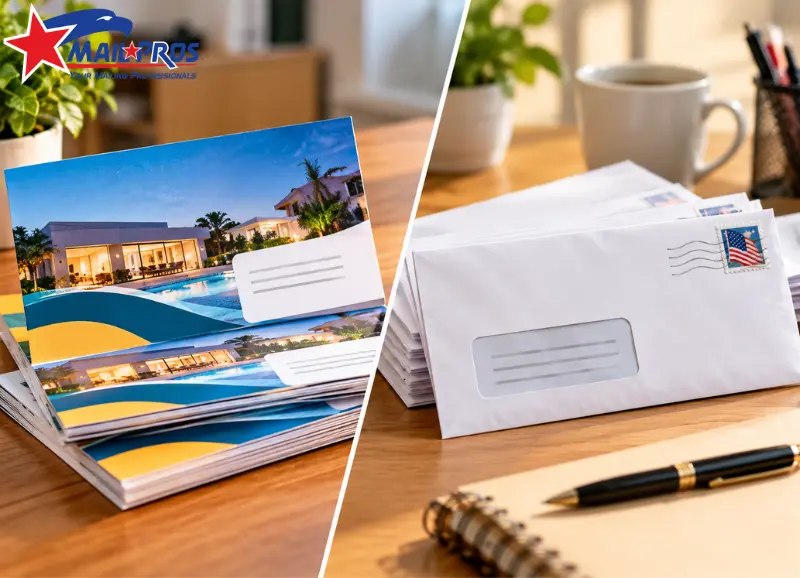
Under USPS rules, a folded self-mailer is one or more unbound sheets, folded and sealed into a letter-size piece. Nothing wraps it. The address, postage, and whole pitch sit on the outside.

Enveloped mail flips that. Only a name and a return address show, and the letter stays tucked away until somebody slides a thumb under the seal.

A shop set up for direct mail printing and mailing can run either job off one artwork brief, so it pays to line these two direct mail formats up before you commit.

Self Mailers Usually Cost Less To Produce

new movers direct mailing

In direct mail, people assume the savings live in postage. They almost never do.

Equal Postage For Letter-Size Pieces

USPS charges a letter-size piece the same First-Class Mail or Marketing Mail letter rate whether it’s folded or stuffed. Budgets go sideways when a designer keeps adding panels. Creep past 6-1/8 inches tall or 11-1/2 inches long, and USPS bills the piece as a flat. That stings. 

A 1-ounce First-Class stamp has cost $0.82 since July 12, 2026, and a 1-ounce flat runs about twice that. Put the finished size on every request for folded self-mailer printing.

Hidden Costs In Envelope Packages

An envelope package is really two to four print jobs that have to line up. Business envelope printing usually gets its own line on the quote, since envelopes run on different stock. Custom envelope printing with a window, a teaser, or your brand blue adds setup time on top.

Letters then get folded, inserted, matched to the right envelope when names appear on both, and sealed. Most mail houses handle that through their fulfillment services and charge per thousand pieces. The folded format skips the whole assembly line. One sheet, one fold, two tabs, an address.

Cost Per Response Over Cost Per Piece

But cheap only counts if the mail still pulls. Say a bi-fold costs 55 cents all-in and brings back 1 reply per 100 pieces. That reply costs you $55. A letter package at 85 cents that brings back 2 per 100 drops each reply to $42.50, pricier piece and all. 

So judge direct mail marketing on cost per response, and ask direct mail printing services to price both versions off one brief.

Design Rules Change Without An Envelope

Inside an envelope, a letter can be flimsy and nobody minds. A folded mailer has to survive high-speed sorters on its own, which is why USPS gets fussy about how it’s built.

USPS Rules For Folded Self Mailers

The fine print lives in DMM 201.3.14, and it trips up more designers than you’d think.

  • Up to 6 x 10⁻¹/2 inches and 1/4 inch thick
  • No more than 3 ounces
  • Final fold on the bottom edge (oblong designs are the exception)
  • Nonperforated tabs, wafer seals, or a glue seal on the open edge
  • At least 70-pound book paper up to 1 ounce, and 80-pound paper above that

Get one wrong, and the mail can lose automation letter pricing. That’s why a self-mailer printing service should check the proof. A fold that opens the wrong way is cheap to fix on screen and expensive once direct mail campaign printing has started.

Envelope Design That Gets Opened

Envelope mail marketing is won or lost on the walk from the mailbox to the kitchen table. A plain #10 with a typed address and a real stamp gets treated like a letter from a person. Add a bright window and a teaser line, and people know it’s an ad, which is fine if the deal is strong. Custom envelope printing should promise what the letter delivers.

Privacy And Sensitive Details

A folded self-mailer keeps no secrets. The carrier, a neighbor, the teenager sorting the pile, any of them can read every panel. Balances, account numbers, and health details go in a sealed envelope. Banks and clinics often add a security tint too, a small envelope printing upgrade that stops the letter from showing through.

Audience And Offer Decide The Better Format
Roofing is a local business in a very practical sense. A contractor may serve an entire city, but the best opportunities are rarely spread evenly across it. One subdivision may have roofs that are 15 to 20 years old. Another may have taken the brunt of a recent hailstorm. A third may sit around several projects the company has already completed. Saturation mailing gives roofers a way to focus on those pockets instead of treating every household as equally valuable. The idea is simple. Choose an area for a sound roofing reason, reach most homes within it, and give homeowners a message that fits what is happening there. Used well, this approach supports direct mail marketing without turning the campaign into a numbers game. More addresses are not automatically better. Better neighborhoods usually matter more. Why Neighborhood Coverage Fits Roofing? Roofing needs often develop across groups of homes. Houses built during the same period can have similar roof ages, and homes on nearby streets experience much of the same weather. Similar Homes Can Face Similar Roof Issues Think about a subdivision built 18 years ago. Not every roof will need replacement at the same time, but more homeowners may be noticing worn shingles, stains, flashing problems, or signs that an inspection would be useful. That is a natural setting for neighborhood marketing. The contractor is not claiming that any individual home has a problem. It is simply placing relevant information in an area where the subject is likely to matter. Storms create another clear use case. After hail or strong wind, local advertising can focus on inspection awareness and common warning signs. Claims should remain factual. A postcard should never suggest that a specific roof is damaged unless that has actually been confirmed. For a closer look at broad route coverage, see Saturation Mailing Lists for Business Marketing Growth. Staying Near Existing Work Has Real Value A lead ten minutes from an active project is easier to inspect and schedule than a similar lead far outside the normal service pattern. That is why roofing advertising should consider operations as well as reach. Good neighborhood marketing also keeps the company visible where crews and sales teams already spend time. Existing jobs, previous customers, crew travel, and service boundaries can all help decide where the next mailing should go. This kind of local marketing keeps attention on places the business can realistically serve. How Roofers Should Choose Mailing Areas? Route selection deserves more thought than postcard design. A beautiful card sent to the wrong neighborhood is still the wrong campaign. Start with the service area, then look for reasons one part of it deserves attention now. Look Beyond the Number of Addresses Housing age, property type, recent weather, nearby projects, customer concentration, and travel time can all be useful signals. Suppose one route has 600 homes around three recent roofing projects while another has 1,000 newer homes across town. The smaller route may be the stronger choice because the company already has local proof and the housing stock is more relevant. That is the kind of decision that separates useful roofing marketing from mass distribution. For address-level planning, Saturation Mailing Lists can support broad residential coverage within selected areas. Broad neighborhood coverage makes the most sense when a meaningful share of the route could care about the offer. When the audience is much narrower, targeted mailing may be more efficient. A storm inspection message might suit a broad neighborhood. A specialized offer tied to a particular property profile may call for targeted mailing instead. That decision can influence roofing leads before a single card is printed. What the Roofing Mailer Should Say? A homeowner should understand the point of the piece almost immediately. The best message usually comes from the reason the neighborhood was chosen in the first place. Write for the Situation, Not the Service Menu A storm-affected area may need information about inspections and visible damage signs. An older subdivision may respond better to information about aging shingles, repair warning signs, or replacement planning. This is one of the most useful roofing marketing ideas because it keeps the message tied to a real local condition. For more route-based examples, see EDDM Direct Mail Strategy for Local Marketing. Good postcard marketing does not need a long list of services. One clear headline, one relevant image, a short explanation, trust signals, contact information, and one obvious next step are usually enough. Trying to fit roof replacement, leak repair, gutters, siding, financing, warranties, and several offers onto one card makes the homeowner work too hard. Use Proof a Homeowner Can Check Roofing is part of home services marketing, and trust matters before a homeowner invites a contractor onto the property. Useful proof may include an applicable license, real customer reviews, manufacturer credentials, accurately stated warranties, and photographs of completed work. Nearby projects can be especially helpful. If the company has genuinely worked in the area, that fact gives the homeowner something concrete to connect with. That makes roofing advertising more credible than broad claims such as being the best company in town. A second postcard marketing touch can build on the first without repeating it word for word. How Repetition and Tracking Work Together? A homeowner can receive a card today and need roofing help two months later. That is normal. Roofing demand does not follow the mailing calendar. Change the Reason to Pay Attention Direct mail campaigns can build recognition when each mailing has a purpose. One piece might focus on seasonal inspections. Another could explain common warning signs. A later card could feature a nearby project or a replacement offer. That kind of repetition can work, but timing should follow weather, seasonality, service capacity, budget, and previous results. The same rule applies to roofing marketing ideas in general. Repeat what remains useful, not simply what is already scheduled. Measure the Full Path to a Sale Calls are only the first step. Roofing leads should be followed through inspections, estimates, signed work, and revenue. roofing marketing ideas One route may generate fewer calls but more signed roofs. That route may be far more valuable. This is where direct mail campaigns become easier to improve. The company can compare real business outcomes instead of judging success by how many pieces were delivered. Professional mailing services can handle list preparation, printing, postal preparation, and delivery. The roofing company still needs a dependable process for answering inquiries and following up after estimates. For campaign execution, Direct Mail Marketing Services covers the production side. Frequently Asked Questions What is saturation mailing for a roofing company? Saturation mailing is a geographic approach that reaches most or nearly all deliverable homes within selected neighborhoods or carrier routes. Roofers can use it where inspection, repair, storm restoration, or replacement may be relevant to a broad local audience. Is saturation mailing the same as EDDM? No. EDDM is a specific USPS program based on carrier routes. The broader approach described here can also use address data to reach a high share of homes within a chosen geographic area. Can roofers use it after a hail or windstorm? Yes, when the message is accurate. A contractor can promote inspections or explain warning signs after severe weather, but it should not claim that a particular home has damage without evidence. What should a roofing postcard include? A strong roofing postcard should include one clear message, a relevant project image, trustworthy business information, easy contact details, and one main call to action. How often should a roofer mail the same neighborhood? There is no universal schedule. Timing should depend on weather, seasonality, service capacity, previous results, budget, and whether the next message gives homeowners a fresh reason to pay attention. To Sum Up Saturation mailing works best when the route, message, and sales process connect naturally. Choose neighborhoods the company can serve well. Look for a real roofing reason to contact them. Keep the message focused. Use proof homeowners can verify. Track the campaign beyond the first call. That approach gives direct mail a practical role in roofing marketing and makes local advertising easier to evaluate over time. For roofers ready to build a more focused neighborhood campaign, MailPros USA can support the data, production, postal preparation, and mailing services needed to move from route selection to delivery. That support can also fit within a wider home services marketing plan.

Costs and rules narrow the choice. Who’s opening the mailbox, and what you’re asking them to do, settles it.

Where Self Mailers Perform Best

Folded mailers do their best work when the offer is short and has a clock on it. Think of a pizza shop’s new menu, an HVAC company booking fall tune-ups, or a Saturday grand opening. Six panels give the photos, prices, and map room to breathe, and a good piece ends up on the fridge instead of in the bin. That’s the shelf life time-bound direct mail advertising is after.

Personal touches help, too. When Lob surveyed 2,000 U.S. adults in 2025, 67% pointed to something personalized as what got them to act. Custom self-mailer printing can drop a different name, store map, or promo code onto every piece.

When Envelopes Earn The Extra Cost

Then there are offers people won’t act on until they trust you, like insurance renewals, loan offers, donation appeals, or anything a lawyer touched. Those need a real letter with room to make the case, plus a business reply envelope.

Business mail is the other place envelope mail marketing earns its keep. A front desk weeds out obvious ads before the boss sees them, and self mailers are about as obvious as mail gets. A sealed envelope with clean business envelope printing reads like correspondence, which gives it a fighting chance of reaching the right desk.

Testing Both Formats Gives The Clearest Answer

Industry averages for direct mail come from lists and offers that have nothing to do with yours. Lob’s June 2026 guide landed in the same spot, saying the right pick depends on the audience, the offer, and “how much your message needs to breathe.”

  1. Start with a clean list. Run it through NCOA and CASS, and our post on fixing an outdated customer mailing list walks through how.
  2. Split the names at random, half and half.
  3. Change nothing but the format. Same offer, same deadline, same in-home date.
  4. Give each half its own phone number, promo code, or QR code.
  5. After the same number of weeks, compare cost per response and cost per sale.
  6. Roll the winner out next time, but keep a small control group in later direct mail campaign printing.

Plenty of programs end up using both, a wide drop of self mailers to get noticed and an envelope afterward for the people who raised a hand. One self-mailer printing service handling both halves keeps the dates in step and the comparison honest.

Frequently Asked Questions

What Is A Self Mailer?

It’s any mail piece that goes out without an envelope, folded, sealed with tabs or glue, and addressed on an outer panel. Postcards are close relatives, and our guide on choosing between a postcard and a folded mailer covers when one card is enough.

Are Self Mailers Cheaper To Send Than Envelopes?

Not at the post office, usually. Both pay letter rates inside USPS letter-size rules. The savings come earlier, since a bi-fold never needs envelope printing or inserting, so get line-item quotes from direct mail printing services on both.

What Size Can A Folded Mailer Be?

Up to 6 x 10⁻¹/2 inches, 1/4 inch thick, and 3 ounces. Plenty of businesses land on a 5-1/2 x 8-1/2 inch bi-fold. Hand your folded self-mailer printing vendor the finished size before anyone builds artwork.

Do Envelopes Get Better Response Rates?

Often, when the offer is big-ticket, the list is B2B, or the pitch rests on trust. For short consumer direct mail advertising, a bi-fold can hold its own for less money. Response swings a lot across direct mail formats, so test your own list.

Can A Self Mailer Be Personalized?

Yes. Digital presses running custom self-mailer printing can change the name, offer, map, and code on every piece in one run. Just leave account numbers and health details off.

Choose The Format That Fits Your Message

Pick self mailers for short, visual offers going out wide. When the sale hinges on trust, privacy, or a longer explanation, the envelope is worth the extra few cents. Check the USPS size rules before anyone opens a design file, and let a split test break any tie. 

MailProsUSA runs direct mail printing and mailing for both formats from a single order. Send over your list size, your offer, and the week you want it in homes, and we’ll put together a side-by-side quote, so your next direct mail marketing drop rests on real numbers.