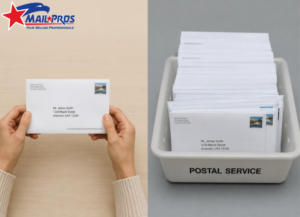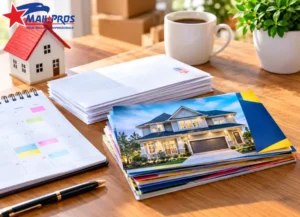

A successful direct mail campaign connects five decisions before anything is printed. The business must know what action it wants, who should receive the mail, why the offer matters, how the piece will meet postal requirements, and how every response will be measured. When those decisions support one another, the campaign is easier to manage and improve.
At MailProsUSA, planning begins with the campaign goal, target area, quantity, budget, and intended in-home window. Reviewing them early helps prevent artwork changes caused by an unconfirmed audience, postage plan, or response path.
Businesses comparing formats, mailing options, and production support can begin with the direct mail marketing service overview.
Define One Business Result Before Designing
Choose the Conversion and Response Window
One mailpiece should lead toward one primary action. Multiple phone numbers, competing offers, and several calls to action make it harder for the recipient to decide what to do.
Choose a conversion that can be recorded, such as
- Booking an appointment
- Requesting an estimate
- Redeeming an offer
- Visiting a store
- Reactivating an inactive account
- Add a quantity and response window. “Generate leads” is vague. “Generate 35 qualified estimate requests within 30 days of the first in-home date” gives sales and marketing the same target.
Establish the Financial Limit
Planning a successful direct mail campaign requires a break-even calculation. Include data, design, printing, processing, postage, landing-page work, and tracking in the budget.
Use two basic calculations.
- Break-even customers equals total campaign cost divided by gross profit from the first purchase
- Cost per acquisition equals total campaign cost divided by new customers gained
If a campaign costs $6,000 and the first purchase produces $300 in gross profit, 20 new customers are required to recover the expense. Customer lifetime value may support a higher acquisition cost, but first-order economics should remain visible.
Match the Audience to the Offer
Select the Right Coverage Model
Audience strategy depends on how broadly the offer applies. A customer list works for retention, cross-selling, and reactivation. A targeted list fits offers influenced by household or business characteristics. Carrier-route coverage suits local offers relevant to most addresses in a service area.
A roofer may prioritize homeowners. A restaurant opening may need broad coverage nearby. A commercial supplier may filter by industry or company size. Targeted direct mail marketing supports person-level or business-level selection.
Every Door Direct Mail reaches eligible addresses on selected carrier routes without a conventional named list. Current size, quantity, preparation, and entry rules should be checked before approving artwork.
Clean and Divide the Mailing Data
Never move an unreviewed spreadsheet into production. Standardize names, street information, suite numbers, and ZIP Codes. Remove duplicates, incomplete records, known undeliverable entries, and suppressed contacts.
Divide the audience by its relationship with the business. Current customers, former customers, and new prospects may need different offers or proof. A new mover direct mail program can reach relocated households while they evaluate local providers.
Begin with two or three segments that have a clear reason to receive different messages. Each variation should reflect need, timing, location, or customer status.
Build the Offer and Mailpiece Together
Write for a Fast Decision
A successful direct mail campaign makes its value clear on the first scan. The headline identifies an outcome or problem. The offer explains what the recipient receives. Proof reduces doubt, and the call to action states the next step.
A practical message sequence is
- State the most relevant customer outcome.
- Present one specific offer.
- Add credible proof or a useful qualification.
- Explain exactly how to respond.
- Display the deadline and important conditions.
“Schedule a spring HVAC tune-up by April 30 and receive a written system report” is clearer than “Call for seasonal savings.” Use genuine deadlines and readable eligibility terms.
Choose a Format That Supports the Decision
Postcards suit visible offers, reminders, and local services. Letters provide room for financial, nonprofit, or complex service messages. Self-mailers and brochures organize several benefits without a separate envelope.
Format should reflect message depth, privacy needs, production cost, and postal eligibility. An oversized piece may change printing and postage costs. Request a complete estimate before finalizing dimensions or stock.
Create a clear reading path from headline to offer, proof, and response. Use readable type, strong contrast, and open space. Local images, maps, names, and variable offers can improve relevance when the data is reliable. Customized direct mail supports these variations without forcing every segment into one layout.
Complete Postal and Response Preflight
Review Data and Postal Requirements
Complete postal review before final design approval. Eligibility may depend on dimensions, thickness, weight, address placement, folds, tabs, coating, and mail class. Late corrections may require redesign or a higher postage category.
Ask whether data will be processed with CASS-certified address-matching software and a Move Update method such as NCOALink. The CASS certification program evaluates address-matching software against USPS standards. NCOALink compares records with change-of-address information. The USPS address quality guidance explains why current, standardized data matters.
Confirm the audience count, finished size, stock, address block, barcode area, mail class, entry plan, proof, schedule, and in-home window before release.
Test the Complete Response Experience
For a successful direct mail campaign, the response route must work before printing. Scan the printed QR code from different phones. Test the short URL, submit the form, and confirm that the lead reaches the correct team.
Phone numbers, offer codes, personalized URLs, and QR codes can identify responses. The landing page should repeat the mailpiece offer and deadline. Staff must also know the offer conditions.
Businesses coordinating print, audience data, delivery tracking, and digital response tools can review Direct Mail Plus after approving the campaign plan.
Measure the Result and Improve the Next Mailing
Separate Delivery Activity From Business Results
Mail-processing activity does not equal customer action. Track qualified responses, conversion rate, revenue, gross profit, cost per acquisition, and return on investment.
Response rate equals responses divided by delivered pieces. Conversion rate equals completed sales or appointments divided by responses. Calculate return on investment with campaign profit and total cost, not revenue alone.
Matchback analysis can identify recipients who purchased through another route. Use consistent match rules and attribution windows across campaigns.
Test One Meaningful Variable
Change one major element at a time. Comparable groups might receive different offers, headlines, formats, or calls to action. Changing the audience, design, timing, and offer together hides the cause of the result.
Record the audience rules, creative version, mail date, tracking code, response window, and outcome. Keep the stronger element and use the lesson in the next test.
Frequently Asked Questions
How Much Does a Direct Mail Campaign Cost?
Cost depends on quantity, data, format, stock, personalization, postage, and mail class. Request a line-item estimate for data, design, printing, processing, and postage. Compare expected acquisition cost, not printing price alone.
How Far Ahead Should a Business Plan a Mailing?
A postcard campaign often needs three to four weeks for strategy, data, design, proofing, production, and postal entry. Large quantities or fixed event dates may need more time. Plan backward from the preferred in-home window.
Is EDDM Better Than a Targeted Mailing List?
EDDM suits broad local offers when most households on a route are relevant. A targeted list fits campaigns where household or business characteristics determine eligibility. Compare cost per qualified prospect and confirm current USPS EDDM requirements before production.
What Is a Good Direct Mail Response Rate?
No single rate applies to every industry, audience, and offer. Compare similar campaigns using qualified responses, conversions, gross profit, and acquisition cost rather than response volume alone.
Which Direct Mail Format Produces the Best Results?
The best format supports the offer and buying decision at an acceptable cost. Postcards suit concise messages. Letters support detail. Self-mailers and brochures provide more space. Test comparable formats when uncertain.
Final Thoughts
A successful direct mail campaign is built from connected decisions, not isolated design choices. Define one conversion, calculate the financial limit, select and clean the audience, present a credible offer, confirm postal eligibility, and test every response route before production.
To move from planning to a USPS-ready mailing, visit MailProsUSA. Send the campaign goal, target area, estimated quantity, budget, and preferred in-home window. Request a line-item plan, approve the tracking method, and schedule a production review or test mailing.