Route vs. ZIP Targeting: Choosing the Right Mailing Area

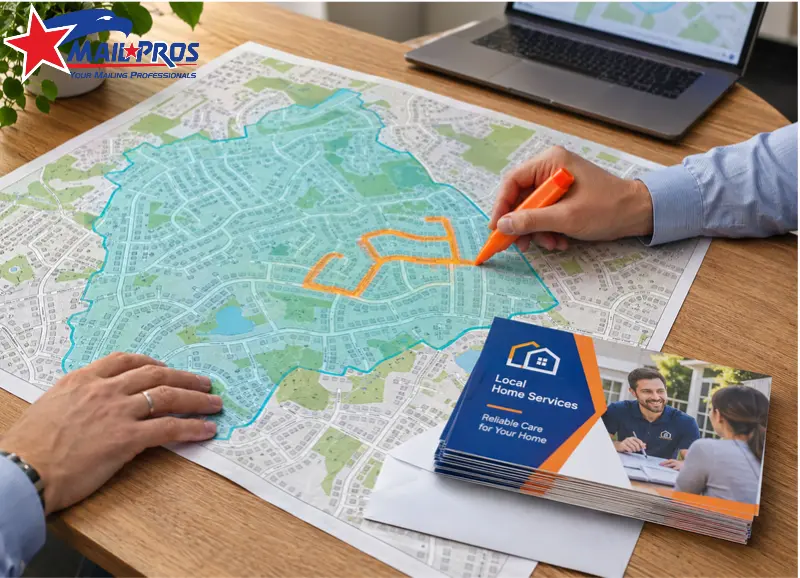
Both ZIP code targeting and carrier routes allow you to target specific households using a mail merge. However, ZIP codes cover many more delivery points than carrier routes. A carrier route only covers the houses on a letter carrier’s route.
If you use the wrong targeting method, the cost of your mail shot may be wasted on people who will never contact you. This guide covers how best to use each option, and how to combine them to get better targeting.
ZIP Targeting and Carrier Routes Explained
Both are based on the same address system provided by the USPS. Within every 5-digit ZIP code, there are multiple carrier routes.
Check ZIP Targeting Coverage
Using ZIP targeting, you can see how much coverage you will have in your mail shot. Please note that ZIP codes do not represent cities; they rarely match a community. It is possible to have a mix of different types of housing within one ZIP code – perhaps some luxury private housing and some student rental housing.
By mailing to this ZIP code, you will be sending to both. Using filtered ZIP code mailing lists can help by allowing you to only mail to homeowners within a particular age range or within a certain income bracket.
Read Carrier Route Codes
Each carrier route within a ZIP code will have an identifier added—for example, C012. The first letter indicates what kind of route it is: C = City route, R = Rural area, H = Highway contract route, B = Postbox area. Within most residential areas, there are only a few hundred addresses on a route. Therefore, using carrier route targeting allows you to target specific streets within a town.
| Factor | ZIP Code Level | Carrier Route Level |
| Area size | Thousands of addresses | Often a few hundred addresses |
| Precision | Whole-code coverage | Street-level selection |
| Mailing list | Needed for filtered mail | Not needed for EDDM |
| Best fit | Regional reach | Neighborhoods near one location |
Choosing a Mailing Area by Coverage and Precision

Three checks settle most decisions before a single piece is printed.
Map Current Customers First
If customers are well distributed within 2-3 ZIP Codes, full ZIP Code targeting will have low wastage. If customers are heavily concentrated within a mile radius of your store, full ZIP Code targeting will mean you reach many houses that otherwise wouldn’t visit your store often. Try to target based on real customer data.
Match Precision to the Offer
If you are offering a service to almost all local households, such as pizza delivery, you may not be able to target as selectively as a company offering a swimming pool building service, or senior accommodation. If your offer depends on people owning a house, owning a valuable house and/or their age, then targeted mailing within a ZIP Code will be more efficient than flooding the area. With route targeting, you are sending the mail to every house within a route, regardless of whether they qualify.
Decide on Named or Saturation Mail
Flooding does not include targeted names. As EDDM mail goes to ‘Postal Customer’, you don’t need to purchase lists. In order to qualify for flooding rates, you must be reaching either 90% of active residential addresses, or 75% of all addresses within each route. An experienced EDDM mailing service will prepare your route bundles and facing slips to meet what the Post Office expects.
Targeted mail will be more expensive. However, it allows for personalisation. You will be able to track more effectively and follow up. Targeting with carrier route lists provides complete coverage of routes, but includes a name on all the mail.
Best Uses for ZIP Targeting
Full ZIP code targeting is cost-effective in these situations:
- Offering a service (such as HVAC, roofing & pest control) that you deliver to locations throughout a region
- Very specific offers to certain households. ZIP targeting with exclusions for non-homeowners ensures unsuitable recipients are excluded.
- Chain promotion in multiple markets, within the same week.
- You need to include a name on all mail in order to follow up.
After a hailstorm, a roofer may have damage across entire ZIP Codes. Using targeted direct mail, you can add exclusions for people who are renters (so they won’t be able to be approved for a new roof) and people whose homes aren’t valuable enough. So they won’t be sent the mail.
Best Uses for Carrier Route Mailing
Route targeting is ideal for businesses in fixed locations, where many homes in the surrounding area may be potential customers. This includes restaurants, salons, gyms, and dentists. Route targeting is good for small budgets. At the moment, Retail EDDM mailers can send between 200-5000 mailings within a ZIP Code per day, without requiring a permit. If the target area is only a few blocks, consider door hangers instead of EDDM, as rarely will a full route cover such a small area.
When using EDDM marketing, the USPS route tool will let you know how many businesses and residents are in each route. It will also give you average age, income, and household size within the route (based on census data). When comparing routes, it is useful to understand these figures, but not individual households.
A Combined ZIP Targeting and Route Plan
Most local marketing will perform best combining both types of targeting. Targeting can achieve broad awareness across whole ZIP codes, while specific routes can be targeted to maximise sales from streets that already generate sales.
Code Your Customer File
Input customer addresses into CASS-certified software. This will give you a carrier route code for each customer. You can easily identify which routes are bringing in customers, and which bring in none. Many targeted direct mail solutions include this step.
Rank Routes by Customer Share
Within each route, divide the number of current customers by the total number of households. A route with 40 customers within 500 households performs better than a route with only 5 customers within 700 households. Within route mapping software, you can easily highlight clusters and gaps in customer distribution.
Cut Routes That Do Not Fit
If you are targeting homeowners, remove routes with high numbers of businesses. If your offer requires a garden/garage, remove routes with high numbers of apartments. As the make-up of areas changes over time, check with your bulk mail provider to get updated figures just before finalising files for printing.
Track Each Zone Separately
Assign a different promo code, number, or QR link for each ZIP code/route group. After sending 2/3 direct mail campaigns, you can see which zones performed best and worst. From this point, targeted direct mail can be accurately measured.
Costly ZIP Targeting Mistakes to Avoid
Despite being able to assign each piece of direct mail to a specific area and knowing exactly where money is being wasted in your saturation mail campaigns, the same common mistakes mean money is wasted in most cases.
- Considering a ZIP code as one area, despite large differences in property types.
- Using general data, rather than targeting lists to exclude renters.
- Leaving business addresses in mixed routes, meaning more mail is sent without additional customers.
- Not allowing enough time for recognition.
Frequently Asked Questions
What Is the Difference Between ZIP Code and Carrier Route Targeting?
With ZIP Code targeting, every address or filtered addresses within a postal code are targeted. With Carrier Route Targeting, individual delivery routes (often containing hundreds of addresses) are targeted.
Will Carrier Route Targeting be cheaper than ZIP Code targeting?
Generally, at present, EDDM retail flats cost $0.26 each. There is no cost for using a list; however, if using a named list, there will be a greater cost. However, with accurate targeting, less waste can occur within a mail campaign with only certain households being eligible.
How many addresses in a Carrier Route?
This can vary. Many routes contain a few hundred addresses. In densely populated urban areas or large rural areas, there may be more. When setting up your mail run with USPS, you can find out exactly how many addresses are contained in the route.
Can I target specific streets within a ZIP Code?
Yes. While Carrier Route Targeting allows you to choose specific routes, ZIP codes can also be narrowed down to specific streets or radii. We can give you a price for both options.
How frequently should I mail to the same area?
We suggest sending mail at least 3 times, spaced a few weeks apart. This helps create brand awareness and can highlight which routes should be prioritised with more of your budget. Both EDDM and ZIP code campaigns follow this pattern.
To Sum Up
If customers are scattered throughout the area or require filtering on a household basis, then mailing to full ZIP Codes is suitable. Alternatively, if customers are closely grouped around one area, carrier routes may be more appropriate. Map out customer locations, target routes that perform well, and try new areas with tracked offers.
Well-planned geographical targeting (including ZIP Code targeting) with clean data means that you will get more calls from the same budget. This makes for effective direct mail targeting.
Plan, print, and send targeted direct mail campaigns by ZIP Code or Carrier Route with MailProsUSA. As a bulk mailer, we can provide targeted direct mail services, targeted mailing lists, and targeted direct mail solutions.
We can map out your service area, find out how many addresses are in your chosen routes, and calculate postage costs for you ahead of your next mail run. Get a quote now and reach real buyers on specific streets within your area with targeted direct mail.