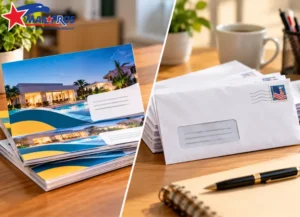
Product Catalog Booklets: Finding the Right Size for Printing

Put the catalog-size question to a commercial printer and the answer is usually 8.5 x 11 inches, often before the question is finished. It’s a fair default for a product catalog. Letter trim fits a three-column grid and wastes very little of the press sheet. Still, a shop selling twelve candles and a distributor with four hundred fittings shouldn’t end up with the same booklet.
Standard Booklet Sizes On A Printer’s Menu
Printers don’t love odd sizes. After all, presses are set up around a handful of trims, and anything off that menu costs more in paper and makeready. For custom catalog printing, the usual menu runs 5.5 x 8.5, 8.5 x 11, and a square or two. Six by nine sits in a gray zone; one plant calls it standard, the next calls it custom. Here is how those booklet dimensions line up by catalog type.
| Trim Size | Common Catalog Use | Products Per Page | Usual Mail Class |
| 5.5 x 8.5 inches | Price lists, short lines | 1 to 2 | Letter, if 3 ounces or less |
| 6 x 9 inches | Gift guides, package inserts | 2 to 4 | Letter, if 3 ounces or less |
| 8.5 x 11 inches | Full lines, B2B supply catalogs | 6 to 9 | Flat |
| 9 x 12 inches | Apparel, furniture, home décor | 4 to 6 | Flat |
| 8.5 x 8.5 or 12 x 12 inches | Lookbooks and design-led brands | 1 to 4 | Flat |
Spec-heavy pages are why letter size keeps winning among printed catalogs. Go smaller and the piece gets lighter, which can (not always) bring postage down.
Product Count Decides The Right Catalog Booklet Size

Count Every SKU First
Before anyone argues about trim size, somebody has to count the SKUs, and the products aren’t equal. For example, a brass ball valve might need six lines of specs plus a drawing; a soy candle gets by on one photo. Until that count exists, comparing booklet sizes is mostly guesswork.
At four or five items, a bound piece is overkill, and postcards and self-mailers carry that offer for less.
Do The Page Count Math
None of this needs software. Divide the product count by products per page, tack on four cover pages, and then round up to the next multiple of four. Run 120 products through it. Letter size, six to a page, gives 24 pages. At 6 x 9 with four per page it’s 34, which becomes 36. Half letter holds two per page and balloons to 64.
The smallest booklet of the three ends up with nearly triple the pages of the letter version (and heavier for it).
Match Size To The Reader
Where a catalog gets read matters too. Purchasing managers often keep a reference copy on the desk for a year, which is why business catalog printing for trade buyers leans toward 8.5 x 11 inches. Fashion and home décor sell on photos, and a 9 x 12 page lets a sofa fill the frame. Trade show handouts and box inserts live in tote bags, so 5.5 x 8.5 or 6 x 9 inches makes more sense.
Binding Rules That Shape Booklet Page Count
A saddle-stitched catalog is a stack of folded sheets, called signatures, with four pages to every sheet. That is why a 22-page booklet plan always becomes 24, leaving room for an order form.
Saddle stitching is cheap and hard to beat for thin books. Somewhere around 60 to 72 pages, depending on the paper, many printers stop offering it. Thick stitched books also show creep. The middle pages work their way outward at the open edge, so the final trim shaves more off them than off the cover.
Perfect binding, the glued spine found on paperbacks, usually starts near 40 pages. Not every trim comes both ways, which can shrink the booklet printing sizes a shop will quote. Request both options when comparing custom booklet printing quotes.
Booklet Size Under The USPS Rulebook
Every copy pays its own postage, which makes the list as important as the trim. A targeted mailing list of recent buyers keeps money away from dead addresses. Then booklet sizes and weight decide the mail class. USPS Business Mail 101 says outright that letters cost less to mail than flats.
Keep Small Catalogs Letter-Size
To get machinable or automation letter prices, a booklet can’t be taller than 6 inches or longer than 10.5. Some designs are capped at 9.5 inches. Three ounces is the weight ceiling and a quarter inch the thickness ceiling. There’s a shape rule too. Length has to land between 1.3 and 2.5 times the height, and the spine usually sits along the bottom edge.
Bind a 5.5 x 8.5 or 6 x 9 catalog on its long side and the size rules take care of themselves. Weight, however, is where these small books tend to fail. USPS Publication 25 draws out each of these booklet dimensions, design by design.
Mail Larger Catalogs As Flats
Anything at 8.5 x 11 or 9 x 12 is too tall for the letter machines, so it goes as a flat. That’s a roomy category, up to 12 x 15 inches and 0.75 inch thick. It got roomier on July 12, 2026, when a USPS rule lifted the Marketing Mail ceiling for flats from 16 ounces to 20 (24 for carrier route flats). Heavy printed catalogs gain headroom, though they still don’t mail as cheaply as letters.
Weigh A Paper Dummy First
Nobody sees weight on a screen, which is why it gets missed. Switch the inside pages from 70 lb. to 100 lb. text and each sheet gets about 40 percent heavier. Shops offering catalog printing services can make a blank dummy on the real paper.
Ten seconds on a postal scale beats a surprise at the post office. Over 3 ounces means four fewer pages or a lighter sheet. From there, bulk mailing services can port the run for commercial rates.
Layouts That Make Catalog Pages Easy To Scan
Size and postage settle the outside of the book. The inside is a different problem, though. The typographer Robert Bringhurst put the goal in one line.
In a catalog the content is the merchandise. Good catalog design lets someone spot a product and compare it with its neighbor without flipping back.
Fit Type And Grid To The Trim
Nine to 11 points is the normal range for catalog body copy. Drop below that to cram one more product onto a small booklet page, and readers start to squint. Prices and item numbers belong in the same corner of every product block, spread after spread.
Use Print-Ready Product Photos
Images need 300 dpi at the size they’ll print, in CMYK, or a crisp 2-inch thumbnail goes mushy across a 9 x 12 spread. For full color catalog printing, a hard copy proof of one spread is the most reliable color check.
Six Pre-Press Checks Before The Booklet Prints

A reprint costs far more than an extra hour of checking. Before files leave the building, a business catalog printing job needs the following.
- A trim that sits on the printer’s list of booklet printing sizes, and a page count divisible by four.
- An eighth of an inch (0.125) of bleed on every outside edge.
- Text and logos at least a quarter inch inside the trim, with a little more room in the gutter.
- Room on the back cover for a clean address panel if the catalog mails without an envelope.
- Address data that’s been cleaned, since an outdated customer mailing list ships expensive catalogs to people who moved years ago.
- A signed hard copy proof before the full run.
Questions Printers Hear About Catalog Sizes
What Size Should A Product Catalog Be?
In the U.S. it’s usually 8.5 x 11 inches, the most common of the standard booklet sizes.
What’s The Cheapest Catalog Size To Mail?
A half-letter or 6 x 9 catalog, provided it passes the USPS letter-size booklet rules and stays at 3 ounces or under. Larger trims pay higher flat prices.
How Many Pages Fit In A Saddle-Stitched Catalog?
Eight is the floor, and counts go up in fours from there. Past roughly 60 to 72 pages, many catalog printing services will steer the job toward perfect binding.
Can A Catalog Use A Custom Trim Size?
Yes. Custom booklet printing covers sizes outside the standard list, but an odd trim can waste press sheet space and change the mail class.
What Resolution Should Catalog Photos Be For Print?
300 dpi at final print size, in CMYK. Anything less shows up fast in full color catalog printing.
Bottom Lines
The right catalog booklet size comes from three numbers found before design starts. Once the products are counted and a dummy has been on the scale, most catalog design and binding questions answer themselves.
MailProsUSA does custom catalog printing, presorting, mailing lists, and fulfillment under one roof. Send the product count and preferred trim for a free quote and mailing plan.