
Find New Movers: Target Recent Arrivals Near Your Business

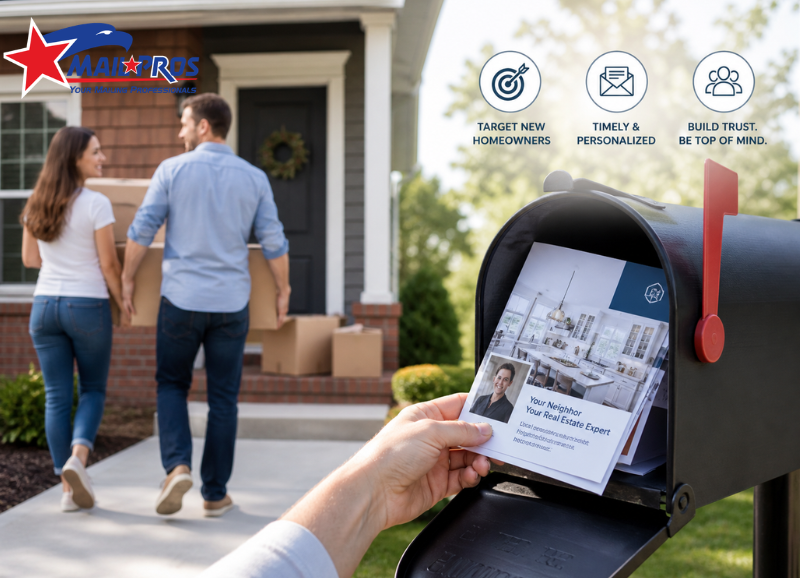
A move changes where a household shops, eats, and hires local services. That creates a useful window when the audience fits the business.
Start with the real service area, narrow records by move timing and customer type, check the list before printing, and track the response.
New movers matter because relocation can reopen decisions about local providers, not because every recent address is automatically a good lead.
Find New Movers Within the Real Service Area
Start with geography. Look at where current customers come from, how far the business can serve profitably, and which ZIP codes fit the offer.
A dental practice may target a short radius, while an HVAC company can cover a wider area. Those limits keep new mover marketing tied to where the business can realistically win customers.
Map the Area Before Buying Data
Do not buy a countywide file simply because the count looks attractive. A smaller area is easier to evaluate.
This is where targeted mail marketing earns its value. The audience is chosen because the business can actually serve it.
A new mover direct mail program can help connect geographic selection with printing and mailing when the campaign needs one workflow.
Check the List Before Printing
Ask a new mover mailing list provider when records are refreshed, what establishes the move date, how duplicates are removed, and what happens to questionable addresses.
Use the same checklist with another supplier. A lower price can hide stale or unusable data. A practical new mover list should let the business control geography and recency before printing.
Build the Audience Around the Service Being Sold

Useful filters depend on the service. A roofer may care about ownership and property type, while a neighborhood restaurant may only need proximity. That distinction creates better new mover prospects than adding criteria with no clear link to the purchase.
Separate Homeowners From Renters
A new homeowner mailing list makes sense when ownership changes the likelihood of buying the service. Roofing, remodeling, landscaping, pest control, and security are common examples.
A new resident mailing list can suit services for renters and owners.
Use targeted mailing lists when the audience needs household-level selection, but keep every filter connected to the offer. If ownership appears to change results, a homeowner-only audience can be tested again later.
Test the Move Window
A household that moved last week may still be arranging essential services, while one that moved three months ago may have already chosen some providers. Split the mover file into sensible time windows while keeping geography and offer consistent.
In practice, new mover marketing becomes easier to judge when timing is tested separately from geography.
Give the Mailpiece a Reason to Arrive Now
Good data cannot rescue a generic offer. The message should connect the move with a genuine local need, such as new-patient availability or home maintenance.
That is the practical side of new mover mail marketing. In a direct mail campaign, the recipient should understand why the piece arrived and what to do next.
Keep the Offer Focused
A new mover mailer should make the offer, relevance, service area, and next step clear.
Trying to fit every service onto one card weakens the main offer. One offer and one primary call to action are clearer.
For short, visual offers, postcard printing is a natural fit. A follow-up piece can focus on another timely need.
Make Follow-Up Feel Different
The second piece should have a different reason to respond. The first may introduce the business. The next can focus on another service, a seasonal need, or a reminder.
That turns the outreach into a sequence instead of repetition. A new movers direct mailing service should explain how fresh records enter the program and how prior recipients are controlled.
Protect the Budget With Better Data Preparation
Review the file before anything goes to print. Check for duplicates, address problems, old records, and households outside the approved geography. If address-quality tools such as CASS, NCOA, or DPV are part of the process, understand what each check contributes instead of treating the acronyms as proof of quality by themselves.
Before the new mover mailer is released, confirm that the approved geography and suppression rules match the final file. For larger addressed jobs, bulk mailing services can keep list processing, printing, presort, and postal preparation in one production path.
Keep Resident Targeting Relevant
Recent-resident data should influence the message, not just the address file. If the creative could be sent unchanged to every household in town, the move insight is probably being underused.
The goal of new mover direct mail is to connect a local service with a need that becomes more important after relocation.
Measure Response Before Expanding the Audience
Even a small first mailing should produce useful information. Use a landing page, QR code, offer code, tracked phone number, or booking-source field, and tie responses to the original geography and move window.
Do not blend new mover leads from different tests if the goal is to learn which audience performs better. Each test group should have a clear reason for being different.
Track the Numbers That Guide the Next Test
Record pieces mailed, total campaign cost, responses, customers acquired, and revenue connected to those customers.
Those numbers make performance easier to improve. Change one major variable at a time so the next direct mail campaign gives a useful comparison.
The same discipline applies to prospecting. Expand the next group of new mover prospects only after the first test gives a reason to do so.
A later targeted mail marketing test can then concentrate on the strongest area, move window, or customer type.
Choose Targeted Lists or Route Coverage for the Right Reason

Not every local mailing needs a named household file. Route-based saturation suits broad neighborhood coverage, while household-level data makes more sense when recent relocation is part of the qualification.
That difference is important because mover-focused direct mail should not be planned like a general neighborhood drop.
Use EDDM for Broad Coverage
USPS Every Door Direct Mail uses selected carrier routes rather than named mover records, making it useful for broad neighborhood coverage.
Businesses are considering every door direct mail services before choosing saturation or household-level selection.
Use Targeted Data When the Household Matters
A new resident mailing list is the better choice when the move itself is part of the reason for mailing.
For campaigns that need household-level criteria, targeted direct mail provides a more selective route than blanket neighborhood coverage.
The audience is easier to evaluate when its definition stays intact from selection through response tracking.
Frequently Asked Questions
How Can I Find New Movers in a Specific ZIP Code?
Use a recent-mover database with ZIP code or radius filtering. Request the count first, then narrow records by move timing and criteria tied to the offer.
What Should I Ask Before Buying a New Mover List?
Ask when records were updated, what establishes the move date, how duplicates are handled, and what address checks are completed. A new mover mailing list provider should be able to answer those questions before the order is placed.
Are Homeowners Better Prospects Than Renters?
It depends on the service. A new homeowner mailing list can be useful when ownership affects the purchase, while many local services can remain relevant to renters and owners.
How Should a Second Mailing Be Handled?
Give the second piece a different job. Use another service angle, seasonal need, or reminder rather than repeating the same creative. A new movers direct mailing service should also prevent the same household from being treated as a fresh record each time.
How Do I Know Whether the Campaign Is Working?
Track responses to the original audience. Compare geography, timing, customer type, and offer before increasing the budget. Keep new mover leads tied to their test group.
To Sum Up
Finding new movers works best when the list connects to a real service area, a timely offer, and a clear way to measure response. Strong new mover mail marketing keeps those three decisions connected from the start. Start narrow, clean the data, and let the first test guide the next one. That keeps outreach to new movers focused on households the business can actually serve.
For businesses ready to turn that process into an ongoing program, MailProsUSA can coordinate audience selection, printing, mailing, and campaign execution. Start with one defined service area and one offer that can be tracked from mailbox to customer.