


A carpet cleaning company with 2,300 names in its billing software has a problem it rarely notices. Most of them were happy with the job, but eighteen months later, when the rug needs cleaning again, few can recall who did it.
That forgetting is the opening printed newsletters were made for. A four-page issue each quarter sits on the fridge or in a kitchen drawer and keeps the company’s name in the house until the next job.
Printed Newsletters Keep Past Customers Coming Back
Prospect lists came in around 4% to 5%. On a file of 3,000 past customers, the gap can be worth a few dozen extra jobs. That is why the house list deserves the first share of a direct mail marketing budget, and why a newsletter is really a customer retention tool.
A postcard gets read standing at the mailbox, if it gets read at all. Most print marketing solutions are built to find strangers. A newsletter goes after people who already paid, and each time somebody picks it up it adds a bit of customer loyalty.
Time Printed Newsletters Around The Buying Cycle
A good issue that shows up a week after the customer booked a competitor is wasted paper. In print marketing, the calendar usually matters more than the design.
Map Each Reorder Window
Two years of order dates will show the usual gap between jobs. An HVAC contractor sees calls bunch up before the first heat wave and the first cold snap, so its issues belong in March and September. A dog groomer with clients on a six-week cycle can simply mail on that cycle. The same order data behind a repeat-purchase path with mail should set the newsletter dates.
Pick A Pace The Team Can Keep
Start with four issues a year. That sounds modest until someone has to write them, and one skipped issue breaks the rhythm that newsletter marketing runs on. Print newsletter marketing services can take design and mailing off the owner’s plate, but topic ideas should come from whoever answers the phone.
Fill Each Page With Content Readers Keep
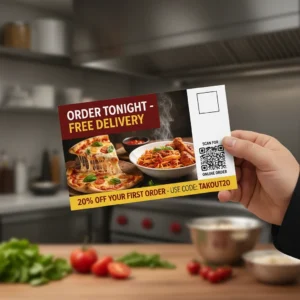
Most readers decide between the fridge and the recycling bin before they get past page one. A flyer can be all pitch. Readers hold a newsletter to the standard of a small local magazine, a higher bar than most printed marketing materials ever face.
Use A Fixed Four-Page Layout
A fixed layout saves design hours and trains readers where to look.
- Page one runs a practical lead story, such as a fall gutter checklist.
- The second page profiles a customer or a technician, with a real photo.
- Page three answers questions customers actually call about.
- The back page holds the offer and the mailing panel.
Keep the trim size, page count and paper stock the same each time, and business newsletter printing costs stay flat. A shop that does professional newsletter printing will keep the specs on file, so nobody has to dig out last year’s order form.
Hold Printed Newsletters To One Sales Page
Once every page pushes a deal, the newsletter reads like print advertising and gets handled like junk mail. One sales page out of four is about the limit. Harvard’s Theodore Levitt said it in The Marketing Imagination back in 1983, writing that “the purpose of a business is to create and keep a customer.” Pages one through three build customer engagement. The back page is where it turns into booked work.
Build Offers That Bring Readers Back
A coupon for 10% off in every single issue mostly teaches people to wait. In good marketing newsletters, the offer on the back follows the last thing the reader paid for.
Offer Reader-Only Perks
People open printed newsletters sooner when something inside cannot be found anywhere else. A plumber might hold first-call scheduling for readers during the first hard freeze, which builds more customer loyalty than a deeper discount. Each offer needs an end date three to four weeks after the in-home date. Coupons without one get stuck under a magnet in October and forgotten until March.
Match Offers To Each Segment
A first-time buyer, a regular and someone who has not ordered in fourteen months should not get the same back page. The first might see a thank-you discount, the regular early booking for spring and the lapsed customer a $20 credit to come back. Variable data printing changes that page for each group in one press run, and the front pages still match the company’s other printed marketing materials. Sort the list by purchase history first, since customized direct mail is only as good as that sort, and most direct mail printing services can take it from there.
Mail Printed Newsletters For Less

Postage gets decided at the design stage, so size and fold belong early in any talk about business newsletter printing.
Fold To Letter Size
The common 11 x 17 sheet folded once to 8.5 x 11 goes out as a flat, and flats are priced well above letters. With a second fold to 5.5 x 8.5 and a couple of tabs, it becomes a letter-size folded self-mailer, as long as the finished size stays at or under 6 by 10.5 inches. Paper weight matters in customer newsletter printing too, since USPS sets minimum weights for self-mailers.
Check Two USPS Rules First
Marketing Mail prices start at 200 pieces or 50 pounds, per USPS Publication 632. Every address also has to be run against change-of-address records, typically through NCOALink, within 95 days of mailing.
Skip the update and the post office still charges for copies addressed to people who moved two years ago, a pure loss in any direct mail marketing budget. Most bulk mailing services run the update while they sort by ZIP code and add barcodes.
Track Printed Newsletters Like A Sales Campaign
Codes go into the files before press, or newsletter marketing gets judged by whoever has the loudest opinion.
Give Every Segment A Code
Each back-page version gets its own offer code, QR code or call-tracking number. A code nobody has used after three weeks is a sign of weak customer engagement in that group.
Measure Against A Holdout Group
Raw response counts flatter the newsletter, because some customers would have called anyway. So pull a small random group off the list, send them nothing and check both groups 60 days later.
When readers rebook at 9% and the holdout group at 6%, the newsletter gets credit for three points, which is the honest read on customer retention. Calls without a sales point somewhere else, and these metrics to check when a mailer brings no sales usually trace it to follow-up.
Common Questions About Printed Newsletters
How Often Should A Business Mail A Customer Newsletter?
Quarterly, for most small businesses, since that pace holds up even in a busy season.
What Does A Printed Newsletter Cost?
That depends on four things, which are page count, paper, quantity and postage class. Ask that any quote for professional newsletter printing shows printing and postage on separate lines. Direct mail printing services that also handle the mailing can put the whole job on one estimate.
Are Print Newsletters Better Than Email Newsletters?
Email wins on speed and cost. Print wins on attention. Printed newsletters reach customers who delete promotional emails unread, and a copy by the coffee maker often gets picked up by someone else in the house. Many small businesses run both, with print marketing and email each doing what it does best.
What Should A Customer Newsletter Include?
One practical lead story, one feature on a customer or employee, and one offer with an end date. The best marketing newsletters also park the phone number and QR code in the same corner every time. Before customer newsletter printing starts on the full run, ask for a printed proof.
How Can A Business Measure Newsletter ROI?
Start with the gross profit from reader purchases above the holdout group’s purchases, subtract the full cost of design, printing and postage, and divide by that cost.
Wrapping It Up
One issue to the last twelve months of buyers, timed before their usual reorder date and coded by version, will show within 60 days whether the idea works. Run it as a sales tool rather than one more piece of print advertising, and printed newsletters can turn one-time buyers into steady repeat customers inside a year.
Print newsletter marketing services that keep design, printing, list cleanup and mailing under one roof save weeks, and MailProsUSA offers print marketing solutions built around exactly those steps.
Request a free quote with your page count, quantity and target mail date, and get the next issue into customers’ hands before a competitor does.