

As a business owner, few things are more frustrating than knowing your ideal customer is just down the street, yet your message isn’t reaching them. We see this all the time in the printing and mail industry. Clients with great local services—a new dental practice, landscaping crew, or pizza shop—often waste budget on digital ads targeting people miles away. Saturation Mailing Lists let them own their immediate area efficiently, reaching the right neighbors without overspending on unnecessary data.
This is where the conversation usually shifts to the concept of Saturation Mailing Lists. Unlike complex demographic lists that filter people by income, age, or buying habits, a saturation list is about total coverage. It is the marketing equivalent of a friendly neighbor knocking on every single door on the block to say hello. When executed correctly, this strategy is often the most cost-effective way to build brand recognition and drive foot traffic for businesses that rely on a local customer base.
However, saturation mailing isn’t a magic button you press to instantly fill your schedule. It requires understanding how postal routes work, designing for a broad audience, and managing the logistics of a high-volume campaign. Over the years, we have helped countless businesses navigate this terrain, and we have learned exactly what separates a campaign that generates a massive ROI from one that ends up in the recycling bin.
Understanding the Mechanics of Residential Saturation
To truly leverage this tool, you have to understand what you are actually buying. When we talk about saturation, we aren’t talking about a list of names; we are talking about geography. Specifically, we are looking at Carrier Routes. A Carrier Route is essentially the daily path a single mail carrier walks or drives to deliver the mail. By utilizing a saturation list, you are telling the post office that you want your piece delivered to every single active residential mailbox on that specific route.
Because you are mailing to everyone in a sequence often utilizing Walk Sequence data the United States Postal Service (USPS) offers significant postage discounts. They don’t have to sort your mail because we, the mail service provider, have already done that work for them. For a small business operating on tight margins, saving pennies on every postcard adds up to hundreds or even thousands of dollars when you are sending out volume.
If you are unsure about the technical side of how data translates into physical mail delivery, it is worth reading up on how saturation lists work. Understanding the backbone of the system helps you realize why the data is so clean and why the costs are generally lower than targeted campaigns. It isn’t just about blasting out mail; it’s about optimizing logistics to get the lowest possible rate per door.
Is a Saturation Strategy Right for Your Business Model?
One of the first questions I ask a new client is, does everyone in this neighborhood have a use for what you sell? This is the litmus test for saturation mailing. If you sell high-end, specialized industrial equipment, mailing every home in a zip code is a waste of money. However, if you are a real estate agent looking for listings, a dry cleaner, or a home improvement contractor, your audience is literally everyone with a mailbox.
We provide various types of mailing lists, and choosing the right one is critical. Saturation lists are the powerhouse for businesses where proximity is the main driver of the purchase. Think about it: most people won’t drive 30 minutes for a slice of pizza or a haircut, but they will absolutely try the new place that just opened five minutes away if they receive a compelling coupon.
In our experience, the businesses that see the highest growth from saturation mailing are those that rely on “radius marketing.” For example, a roofer working on a house in a specific subdivision can use a saturation list to mail just that specific carrier route. The message is simple: We are already working on your neighbor’s roof; we can give you a free estimate while we are here. That creates immediate relevance and trust, which are the cornerstones of conversion.
The Cost-Benefit Analysis: Volume vs. Precision
There is often a debate in the marketing world between quality and quantity. Targeted lists offer quality (precision), while saturation lists offer quantity (volume). But here is the secret that many marketers overlook: sometimes quantity creates quality. When you saturate a market repeatedly, you build “Top of Mind Awareness.” Even if a homeowner doesn’t need your pest control service today, seeing your logo every month ensures you are the first one they call when they see an ant in the kitchen.
This approach is a fundamental part of a broader direct mail marketing strategy. While the postage savings are attractive often allowing you to send 30% to 50% more mail pieces for the same budget as a targeted campaign the real value is in the density. When three neighbors on the same street get your flyer, they talk. You start to look like the dominant player in the area.
However, you must budget for the production costs. While postage is cheaper, you are printing more pieces. We always advise clients to look at the Cost Per Acquisition rather than just the total cost of the mailing. If spending $2,000 on a saturation campaign brings in 50 new long-term customers, the math usually works out far better than spending the same amount on digital ads that get clicked but rarely convert.
Design and Messaging for a Broad Audience
Writing copy for a saturation campaign is different than writing for a targeted list. Since you aren’t speaking to a specific demographic (like “women over 50” or “new parents”), your message needs universal appeal. This is where many businesses trip up they try to be too niche in their messaging. The headline needs to address a common pain point that every homeowner or resident faces.
We recently worked with an HVAC company that wanted to use saturation lists. Their original design was full of technical jargon about SEER ratings and compressor efficiency. We advised them to pivot. The new postcard simply asked, Is your bedroom too hot to sleep in? followed by a strong discount offer for a tune-up. The response rate tripled. Why? Because everyone hates sleeping in a hot room, but very few people care about compressor specs.
The offer is the engine of a saturation mailer. Because you are interrupting someone’s day with unsolicited mail, the value proposition must be immediate. Free and Discount are powerful words here. If you are a restaurant, a Buy One Get One offer is standard because it works. If you are a service provider, a specific dollar amount off your first service is usually more effective than a percentage, because it feels like real money in the customer’s pocket.
Pitfalls to Avoid in Saturation Campaigns
Despite the benefits, we have seen plenty of campaigns flop because of poor planning. One major issue is the one-and-done mentality. A business owner sends out 10,000 postcards, gets a lukewarm response, and decides direct mail doesn’t work. The reality is that response rates climb significantly on the second and third touch. You are building trust, and that takes time.
Another common error involves timing and data hygiene. Even though saturation lists are current resident focused, understanding when to land in the mailbox matters. For instance, mailing a landscaping offer in the dead of winter (unless you do snow removal) is burning cash. You can learn more about these traps by reviewing common saturation list mistakes. Knowing what not to do is just as important as knowing the right steps.
We also see clients skimp on the physical quality of the mail piece. In a saturation campaign, you are competing with bills, magazines, and other flyers. If your piece feels flimsy or looks like it was designed in Microsoft Word 95, it reflects poorly on your business. You don’t need gold foil stamping, but professional design and decent paper stock signal that you are a legitimate, trustworthy business.
Managing the Logistics: From Print to Mailbox
Executing a saturation campaign involves moving parts that most business owners don’t have the time or equipment to handle. It involves list acquisition, CASS certification (to ensure addresses are valid), presorting for postal discounts, inkjet addressing, and delivery to the USPS capabilities. This is where professional fulfillment services become essential.
Attempting to label and stamp 5,000 postcards by hand is not a good use of your time, and you will miss out on the bulk postage rates that make saturation mailing affordable in the first place. A fulfillment partner handles the heavy lifting. We ensure the barcodes are readable by automation machines, which speeds up delivery, and we handle the paperwork required by the post office to prove the mail qualifies for saturation rates.
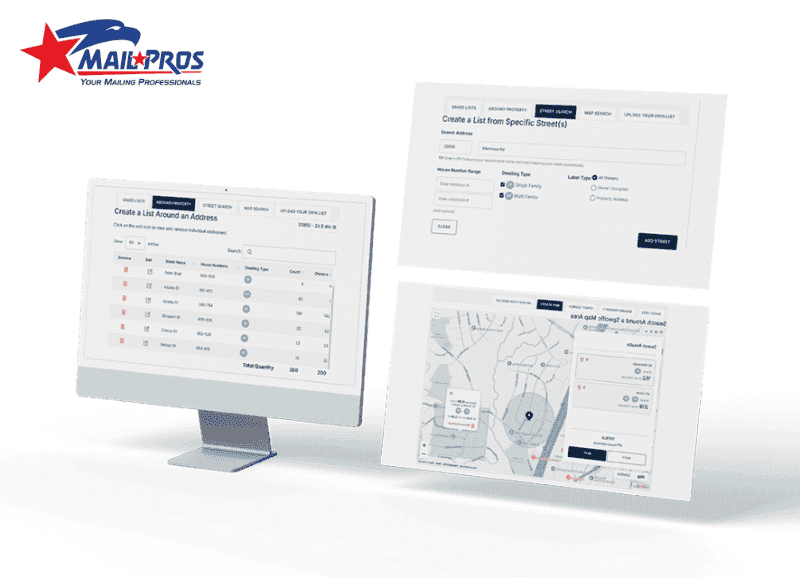
Furthermore, a professional partner can help you map out your territory. We use tools that allow us to look at a map, select specific carrier routes, and see exactly how many single-family homes vs. apartments are on that route. This granularity allows you to trim the fat. If you are a lawn care company, you probably want to exclude apartment complexes from your saturation list. We can filter those out, ensuring you are only paying to reach potential customers with lawns.
Measuring Success and adjusting Strategy
Finally, you cannot improve what you do not measure. Since saturation lists don’t always use a specific name, tracking can seem tricky, but it is actually quite straightforward. We recommend using tracking mechanisms like QR codes, dedicated landing pages (e.g., yoursite.com/save), or call tracking numbers.
However, the simplest method is often the physical coupon. Asking the customer to bring this card in allows you to physically count the redemption rate. If you are a service business, asking how did you hear about us? during the intake call is vital. You need to attribute those leads to the mailing to calculate your true ROI.
Based on the data, you adjust. Maybe Route C performed poorly, but Route A was a goldmine. For the next campaign, you double down on Route A and perhaps test a new adjacent neighborhood. This iterative process turns a marketing expense into a reliable revenue generator.
FAQs
What is saturation in marketing?
Saturation marketing is a strategy where you deliver your message to every single household or prospect within a specific geographic area to ensure 100% market coverage. This approach maximizes local brand awareness by flooding a territory, making sure no potential customer in the neighborhood is missed.
How to grow your email list fast?
The fastest way to grow an email list is to offer an irresistible lead magnet, such as an exclusive discount or free guide, in exchange for a visitor’s contact info. Combine this offer with high-visibility website pop-ups and targeted social media ads to convert traffic into subscribers immediately.
Conclusion
Saturation mailing lists remain one of the most powerful tools for local business growth because they allow you to dominate your immediate market at a fraction of the cost of other channels. By focusing on carrier routes, you ensure that your brand becomes a household name in the neighborhoods that matter most to your bottom line. It removes the guesswork of who to target and replaces it with the certainty of “where” to target.
Success requires more than just ink on paper; it requires strategy, consistency, and a partner who understands the intricacies of the postal system. If you are ready to stop guessing and start growing your local footprint, MailProsUSA is here to help you navigate every step of the process, from selecting the right routes to getting your message into the right hands. Let’s make your business the one everyone on the block talks about.