What Are the Two Major Advantages of Direct Mail Marketing?

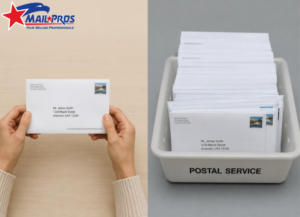
Direct mail marketing offers two major advantages. It gives a business a physical place in the customer’s environment, and it allows campaigns to target selected households or businesses and measure identifiable responses. Together, tangibility and accountable targeting support acquisition, retention, local promotion, and reactivation.
Those advantages are not automatic. Premium paper cannot rescue an irrelevant offer. Effective direct mail marketing services connect the audience, message, format, timing, and response method.
The First Advantage: Tangibility That Supports Action
Physical Mail Can Remain Visible
Online advertising often depends on a brief impression. A mailpiece can remain on a counter, bulletin board, or refrigerator until the recipient needs the service. That matters for purchases requiring planning.
Consider a homeowner who receives a furnace-maintenance postcard in early fall. It may not produce an immediate call. If the offer remains visible when the weather changes, however, the piece can still support the decision.
Paper weight, finish, size, color, and image quality can position a business as economical, practical, premium, or specialized. The most expensive format is not necessarily the right one.
Relevance Makes the Physical Format Personal
Personalization should make the message appropriate to the recipient. Location, customer status, purchase history, service interval, and product interest can improve relevance when the data is accurate and responsibly used.
Customers may respond to reminders, loyalty offers, or related services. Prospects usually need a concise introduction, recognizable proof, and a low-friction reason to try the company.
Useful personalization in direct mail should never feel invasive. Use only information that supports the offer, avoid sensitive personal details, and check variable fields before production. A misspelled name or incorrect customer status does more than look careless; it weakens the trust that personalization is supposed to build.
The Second Advantage: Targeting With Measurable Results
Match the Targeting Method to the Offer
Direct mail can provide broad geographic coverage or narrow audience selection. The offer determines the better method.
| Targeting method | Best suited for | Main limitation |
|---|---|---|
| EDDM carrier routes | Restaurants, local retail, home services, openings, and community events | Reaches most or all addresses on selected routes rather than named individuals |
| Targeted prospect list | Offers tied to relevant household, property, geographic, or business characteristics | List quality and selection criteria directly affect efficiency |
| Customer or house list | Retention, reminders, reactivation, loyalty, and cross-selling | Requires clean, current first-party records |
Every Door Direct Mail, or EDDM, allows businesses to select carrier routes without an individual address list. The USPS EDDM mapping tool includes Census-derived filters such as age, income, and household size. These describe route populations, not individual residents.
For narrower audiences, selected lists provide greater control. MailProsUSA’s guide to EDDM versus targeted mailing lists compares neighborhood saturation with selective outreach.
Before approving postage, remove duplicates, correct incomplete addresses, exclude unprofitable service areas, and suppress ineligible records. Good targeting also determines who should not receive the piece.
Measurement Must Be Planned Before Printing
A campaign becomes measurable when each response can be connected to a specific mailing. Add at least one campaign-level tracking method:
- A QR code leading to a dedicated landing page
- A short URL with tagged analytics
- A campaign-specific coupon or redemption code
- A dedicated call-tracking number
- An in-store source code
- A reply card or business reply envelope
Postal movement is not customer response. USPS Informed Visibility supplies near-real-time tracking for eligible barcoded commercial mail. Processing scans support timing estimates but do not prove a recipient read the piece or made a purchase.
Measure more than response rate. Track conversion rate and customer acquisition cost. For a realistic return calculation, compare attributable gross profit—not sales revenue, with data, design, printing, postage, handling, and fulfillment costs.
Where Direct Mail Campaigns Commonly Lose Money?
The Audience and Offer Do Not Match
A polished piece can fail when the offer has little value to its audience. A broad discount may attract unprofitable orders, while a narrow premium service may be unsuitable for route saturation. Audience, price, buying cycle, and service area must align.
Describe the campaign in one sentence: “We are sending this offer to this audience because this need makes a response reasonable now.” If that depends on assumptions, revisit the targeting.
The same discipline applies to targeted mailing lists. Use criteria related to the offer, compare the audience with customer information, and avoid unnecessary filters.
The Piece Creates Interest but No Clear Next Step
Several phone numbers, web addresses, social profiles, and competing offers can hide the intended action. The primary call to action should be identifiable within seconds.
Give one response path visual priority. Make the offer, deadline, conditions, and next step easy to find. Secondary information should not compete with the conversion goal.
Check inventory, appointment availability, call handling, landing-page performance, and fulfillment before mailing. A response is valuable only when the business can serve it.
A Practical Workflow for Better Campaign Results
Complete These Steps Before Production
Start with one measurable objective, such as booked estimates, store visits, renewals, donations, or completed purchases. Define the audience and exclusion rules, then select the offer and format. Review the mailpiece at actual printed size rather than relying only on an enlarged screen preview.
Test every QR code, URL, phone number, coupon, and variable field. Confirm that the landing page works on mobile. Document quantity, total cost, in-home timing, and the performance target.
Learn From the Campaign After the Drop
Record the mail date, audience source, segment, quantity, returned pieces, responses, conversions, revenue, gross profit, and acquisition cost. Compare segments instead of looking only at the campaign total; a strong neighborhood can be hidden by weaker routes.
Change one meaningful variable per test. Comparable audience groups might receive different offers while other elements remain consistent. Allow for the buying cycle; more inquiries do not always mean more profitable customers.
Frequently Asked Questions
Is direct mail marketing still effective in 2026?
It can be effective when the list, offer, creative, timing, and measurement support one objective. Physical delivery alone does not ensure a response; relevance and follow-up matter.
What is the greatest advantage of direct mail?
Its greatest strength combines physical presence with audience control. Route or list selection concentrates spending on relevant locations or customer groups.
Should a local business use EDDM or a mailing list?
EDDM usually fits businesses with broad neighborhood appeal. A targeted list is more appropriate when eligibility or likely interest depends on specific household, property, customer, or business characteristics.
How should direct mail ROI be calculated?
Track responses with a unique code, URL, QR code, phone number, or reply device. Then compare attributable gross profit with the full campaign cost. Website traffic or response rate alone does not establish profitability.
Which direct mail format receives the best response?
No format wins everywhere. Postcards provide visibility, letters allow explanation, and catalogs support discovery. Choose the simplest format that presents the offer, proof, conditions, and next step.
Conclusion
The two major advantages of direct mail marketing are tangible presence and controlled, measurable targeting. Both require the right audience, relevant offer, suitable format, and a response path established before printing.
Turn the next mailing into a defined business test. Set the audience, exclusions, offer, response method, total budget, and acquisition-cost target first. Then contact MailProsUSA with the campaign goal, service area, estimated quantity, and preferred in-home period. The team can help coordinate targeting, design, printing, EDDM or list-based mailing, and USPS-ready campaign preparation so the project moves from planning to delivery with fewer gaps.