Postcard Printing Paper That Meets USPS Mailing Standards

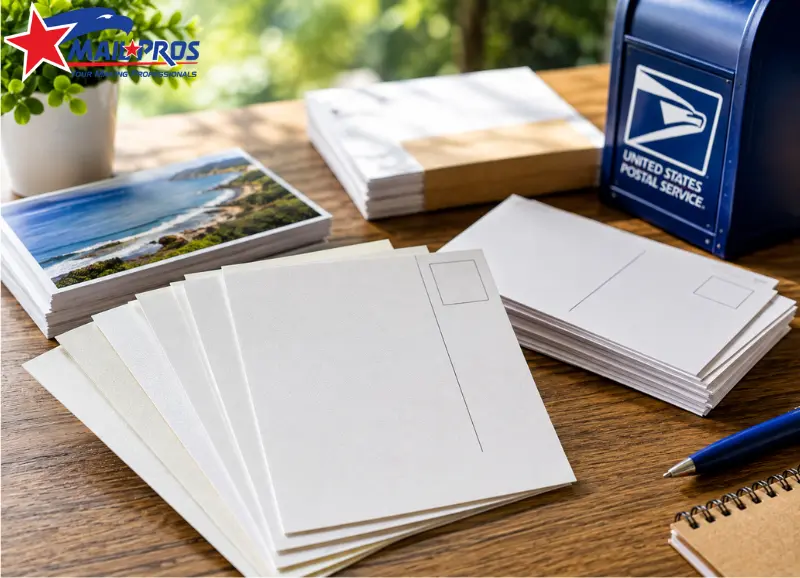
The right postcard printing paper is the stock that fits both the campaign and the USPS category used to mail it. For a retail First-Class Mail postcard, USPS requires a rectangular piece at least 3.5 x 5 inches and no larger than 4.25 x 6 inches, with a finished thickness from 0.007 to 0.016 inch.
What USPS Looks at Before a Postcard Can Mail?
USPS evaluates the completed mailpiece rather than the stock name on a print estimate. Postcard dimensions, thickness, shape, surface, and construction all matter.
Size and Thickness for Retail First-Class Cards
Retail USPS postcards must measure at least 3.5 x 5 inches and no more than 4.25 x 6 inches. A standard 4 x 6 card fits within those postcard size limits when the other requirements are met.
A 5 x 7 card exceeds the retail limit and may fall into another postal category.
USPS also requires a card to be uniformly thick. That matters when postcard design includes raised pieces, unusual attachments, or a finish that changes the surface.
Businesses planning a standard campaign can compare postcard size options through postcard printing services after the postal format is settled.
What Changes With Larger Commercial Cards?
Commercial First-Class cards can be larger than retail cards. USPS allows qualifying commercial cards up to 6 x 9 inches. Once a card exceeds either 4.25 inches high or 6 inches long, the minimum thickness increases to 0.009 inch.
Paper and format should therefore be decided together because a larger card can change postage assumptions.
The current USPS Domestic Mail Manual is the safest reference when a piece sits close to a size or thickness limit.
How to Choose Postcard Printing Paper Without Guessing?
Caliper Matters More Than the Stock Name
Postcard paper weight and caliper are not the same measurement. Basis weight describes a paper grade. Caliper tells you how thick the finished sheet actually is.
Two papers with similar basis weights can finish differently. Ask for a finished caliper and whether that figure includes coating.
Where 10 Pt, 14 Pt, and 16 Pt Fit?
Ten-point stock can suit economical, high-volume promotions. Fourteen-point postcard printing paper is a practical middle ground for many campaigns. Sixteen-point stock feels firmer and can suit premium work, but extra thickness should support a real purpose.
For custom postcard printing, choose between these stocks only after the mail class and finished format are known. The postcard cardstock should support the job without adding unnecessary cost.
How Coating Affects Printing and Addressing?
The finish on postcard printing paper affects color, glare, writing, scuff resistance, and the way an address is applied.
When Gloss Works Well?
Gloss works well for photography and strong color, but the address side still has to accept the production method cleanly.
When Matte or Uncoated Stock Is Better?
Matte reduces glare, while uncoated stock is easier to write on. Postcard cardstock and coating should be reviewed together so the finish supports both creative and production.
Variable campaigns need another layer of proofing, and postcard design should be tested with the longest realistic data. The guide on how postcard mailing services handle variable data explains how names, offers, images, and QR destinations should be tested before a full run.
Match the Paper to the Way the Card Will Be Mailed
Standard and Targeted Mailings
For targeted postcard mailing, settle the list, format, address method, and postage category before production. This is particularly important for business postcard printing because even a small size change can affect the category used for mailing.
A custom postcard makes more sense at this point because the available stock and coating choices can be compared against a known postal format.
Good postcard printing services should make these details clear. A postcard printing company should be able to tell the client what stock is being used, its finished caliper, and whether the selected coating works with addressing equipment.
EDDM Needs Different Planning
EDDM is often grouped with postcard campaigns, but EDDM Retail uses eligible USPS Marketing Mail flats rather than the retail First-Class postcard rules.
That distinction affects postcard printing paper selection because a neighborhood mailer may use a much larger format.
The guide to custom EDDM postcard printing for small businesses explains route selection, size, preparation, and campaign measurement in more detail.
Once the format is confirmed, EDDM postcard printing can be compared without mixing EDDM flat requirements with standard card rules.
What to Check Before You Approve the Print Run?
A PDF proof can confirm copy, artwork, and positioning. It cannot tell you whether the stock feels too light, whether a glossy surface creates glare, or whether the finished card measures as expected.
Check a Physical Sample
For a large business postcard printing order, inspect a physical sample when the stock or finish is unfamiliar. Measure the trim. Look at the address side under ordinary light. Scan any QR code at final size.
For variable data, test long names, apartment lines, missing fields, and QR codes rather than approving only the first record.
This is also a sensible point to recheck USPS postcard requirements before the full quantity is released.
Use a Simple Postal Preflight
Before approving postcard printing paper for production, confirm these items.
- The final trim matches the intended postal category.
- Finished caliper is known.
- The card is flat and uniformly thick.
- The address remains easy to read on the selected finish.
- Postage has been checked against the finished specification.
- Variable fields and QR codes have been tested.
- Specialty finishes have been reviewed before printing.
A direct mail marketing service should connect these print decisions to mailing preparation. That is especially useful when the designer, printer, and mail house are not the same company.
When a Heavier Stock Is Worth the Extra Cost?
Heavier paper can improve presentation, but it should have a job. A premium property campaign may benefit from a firmer card, while a coupon campaign may gain more from better targeting or another mailing.
Treat postcard paper weight as one production choice, not a quality score. Good postcard campaigns succeed because format, audience, offer, creative, and production work together.
The same principle applies when working with a direct mail marketing service. The recommendation should make sense for the campaign objective, not simply increase the print specification.
Frequently Asked Questions
What Paper Is Best for USPS Postcards?
For many mailed postcards, 14 pt or 16 pt stock is a practical starting point. The finished postcard printing paper still has to meet the applicable size, thickness, shape, and construction rules.
What Is the Minimum Thickness for a USPS Postcard?
Retail First-Class card pricing requires at least 0.007 inch thickness. Larger qualifying commercial cards may require at least 0.009 inch. The maximum First-Class card thickness is 0.016 inch.
Does a 5 x 7 Card Get the Standard Postcard Rate?
No. A 5 x 7 card exceeds the retail postcard dimensions allowed for standard card pricing. It may still qualify under another mail category, so postage should be checked before printing.
Can Glossy Cards Be Mailed Through USPS?
Yes. Glossy cards can be mailed when the finished piece meets USPS postcard requirements and the address, postmark, barcode, and other required markings remain legible. Confirm that the coating works with the addressing method.
Is 16 Pt Better Than 14 Pt for Direct Mail Postcards?
Not always. Sixteen-point stock feels firmer, while 14 pt often provides a useful balance of durability, appearance, and cost. The better choice depends on the offer, quantity, finish, and postal category used for the direct mail postcards.
Conclusion
Choosing postcard printing paper should begin with the finished mailpiece rather than the paper rack. Confirm the size, postal category, caliper, coating, and addressing method first. Then select the stock that gives the campaign the right balance of durability, presentation, and cost.
The final postcard printing paper specification should stay with the job. For custom postcard printing, a reliable postcard printing company should explain those specifications before production and flag any change that could affect postage or handling.
When the specifications are ready, MailPros USA can coordinate printing and postcard mailing so the stock, production setup, and postal preparation are aligned before the full run is approved.