
How Postal Route Maps Reduce Direct Mail Campaign Expenses

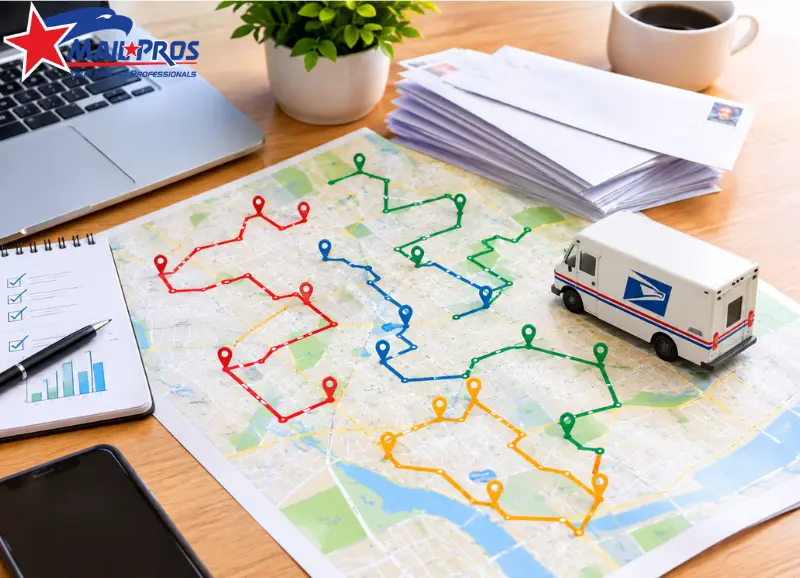
Most local mailers lose money before the ink dries, and the loss rarely comes from paper or postage. It comes from the streets they picked. A roofer prints 8,000 flyers for a five-mile circle, then learns that only 3,400 of those doors are single-family houses. The other 4,600 cost the same to print and deliver.
Postal route maps are the USPS carrier route maps that show every delivery route in a ZIP code with its door count, its home and business split, its Census demographics and its postage cost. Reading them before you order is the cheapest saving in a direct mail marketing budget.
Postal Route Maps Turn A ZIP Code Into Buyable Streets
A carrier route is the path one letter carrier covers in a day, and it is the smallest piece of geography the Post Office will sell. One ZIP code can hold twenty routes, and a street of 1950s houses often sits beside a route of apartment blocks.
USPS publishes the data free inside the EDDM Online Tool. Search an address or ZIP code, click Show Table, and columns for Route, Residential, Total, Age, Size, Income, and Cost fill in for every route. Age, size, and income come from Census data, so they describe a street rather than a family. If the screens are new, our walkthrough of the EDDM map explains them in order.
Read The Counts First
Colors show where a route sits. Counts show whether it earns your money. Put the residential figure beside the total on every route you shortlist. A route with 640 addresses in total and 190 residential ones is mostly offices and storefronts. Postal route maps catch that in seconds. That route is wasted postage for a house-cleaning offer and strong ground for a B2B direct mail campaign.
Filter After You Map
Set the boundary first and filter second. An income filter applied too early hides close routes that win on drive time. Pull every route inside the boundary in the route mapping tool, then narrow by income or age.
Route Data Shows Where A Mailing Budget Leaks
Three leaks cause most of the waste in local campaigns. The route table exposes all three before a print order is signed. The first is radius padding. A circle around your shop crosses routes that belong to another trading area, so outer doors lift the print bill and lower the response rate. The second is housing mismatch.
Roofing, pool, and lawn offers land poorly in apartment-heavy blocks, so direct mail advertising that ignores housing type pays twice. The third is double coverage. Neighboring ZIP codes often share a border route, so those households get the same piece twice.
Four Ways Postal Route Maps Cut Your Cost Per Response
Once the weak routes are gone, four habits keep the savings compounding.
Rank Routes By Drive Time
Sort the shortlist by driving distance, then delete the farthest ten percent. A job sitting behind three competitors rarely converts, and travel time eats its margin.
Match Routes To Ticket Size
A $9,000 renovation pays for higher-income routes with older housing stock. A $39 oil change needs density. Pick the route set that matches what you sell, because coverage alone has never closed a sale.
Print To The Door Count
Take the counts from your route list, add a small overage for spoilage, and order that quantity. Quotes for direct mail printing are built per thousand, so rounding up is money handed over for nothing.
Mail In Two Waves
Send half your routes this month and the rest next month behind the same offer. Log responses by route code such as C012, using a separate phone number or coupon code per wave. Repeat what produced calls and drop the silent routes.
The Postage Math Behind Postal Route Maps
What One Door Costs?
USPS prices EDDM Retail marketing flats at 26 cents a piece and EDDM BMEU flats from 25.9 cents. A retail drop needs at least 200 pieces and allows up to 5,000 a day per ZIP code. Pieces are addressed to Postal Customer, so there is no list rental or addressing charge. Every Door Direct Mail stays cheap because the carrier already walks that street.
| Option | Postage per piece | List needed | Permit needed | Daily limit |
| EDDM Retail | 26 cents | No | No | 5,000 per ZIP code |
| EDDM BMEU | From 25.9 cents | No | Yes | None |
| Saturation Mail | Varies by weight | Yes, in walk sequence | Yes | None |
What One Trim Saves
Postal route maps turn those rates into a forecast. A selection covering 6,400 doors puts postage at $1,664. The table then flags 14 routes holding 2,100 addresses that are mostly rentals and small offices. Cutting them brings postage to $1,118 and takes a third off the print run, a $546 saving.
Larger programs move to permit-based bulk mail services, where saturation rates apply once a mailing runs in walk sequence and reaches 90 percent of residential addresses or 75 percent of all addresses. Coverage is counted route by route, so your plan decides whether you qualify.
“Half the money I spend on advertising is wasted; the trouble is I don’t know which half.”
That line is widely attributed to retailer John Wanamaker. Route codes are how a small mailer answers him.
How To Build A Route Plan In One Sitting
- Mark your service boundary and the drive time you will honestly accept.
- Select every route inside it, then export the counts and costs from the route mapping tool.
- Delete routes whose housing type cannot use your offer.
- Sort what is left by income or age when your offer depends on either.
- Set a budget ceiling, then add routes from the top of that list until you reach it.
- Confirm the drop-off Post Office for the EDDM routes you chose and lock the print quantity.
Keep that sheet. Postal route maps only pay off when this month’s plan can be measured against last month’s results.
Mistakes That Undo A Good Route Plan
A sound plan still comes apart during execution, usually in one of these five ways.
- Mailing a strong route once, when three drops into one good route out-earn one drop across three weak ones.
- Reading route averages as household facts, since Census data describes a street and never a family.
- Forgetting the do not deliver column on facing slips after a customer asks to be removed.
- Rebuilding the route set every month, so no result compounds into a usable pattern.
- Hiring a direct mail company that will not show the route list and door counts before printing.
That last one matters most when you buy postcard mailing services, since a vendor who cannot name your routes cannot explain your results. Size and indicia standards sink plenty of first drops, and the USPS rules for EDDM mailing cover them.
Frequently Asked Questions
What Are Postal Route Maps?
They are USPS carrier route maps showing every delivery route in a ZIP code with its door count, residential and business mix, demographics and postage cost. Mailers use them to buy single routes rather than whole ZIP codes.
How Much Does EDDM Postage Cost Per Piece?
USPS lists EDDM Retail flats at 26 cents and BMEU flats from 25.9 cents, and the EDDM map prices each route as you click it. Mailers who qualify for bulk mail services pay less.
Can I Mail To EDDM Routes Without A Mailing List?
No list is needed. Every Door Direct Mail runs on route codes instead of names, which removes both the list cost and the list decay. Buy data only when your buyer is defined by something a route cannot show.
What Is The Smallest EDDM Mailing I Can Send?
Two hundred pieces, often a single route. Postal route maps keep that test cheap, so route-based direct mail advertising can prove one neighborhood before anything scales.
How Often Do Carrier Route Counts Change?
Counts move as homes are built, vacated and resequenced, so pull fresh figures for every drop. Confirm them the day direct mail printing is scheduled.
Bottom Lines
Route choice does more than shave postage. It decides which households ever see your offer, which moves response further than paper stock or a headline. Set the boundary, pull the counts, cut the routes that cannot buy, and print to the number left.
Run that review before the next drop. Send your service area and offer to MailPros USA, ask for the route list, door counts, and total postage in writing, then hold it against your current plan.
Businesses that buy postcard mailing services this way spend less per mailing and more per customer, and a direct mail company willing to share its postal route maps turns a direct mail marketing budget into repeat business.