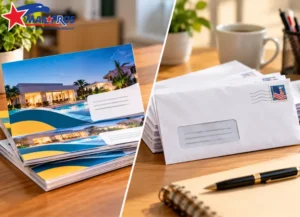
Real Estate Marketing: Postcards vs. Detailed Market Reports


A homeowner on a farm route can get the same agent’s mail for years, then list the week a job transfer comes through. Long gaps like that are normal. Sellers in the latest National
Real estate farming is mostly about still being remembered when that week arrives. Postcards handle remembering. Detailed market reports give people a reason to pick up the phone.
The Different Jobs Of Postcards And Market Reports
A geographic farm runs on repetition, the same as any direct mail marketing program. Most agents draw its edges along carrier routes, and an EDDM map tool shows each route’s household count before anything is printed. What goes into those mailboxes each month is where the two formats split.
Use Postcards For Recognition
Nobody has to open a postcard. The headline gets read between the mailbox and the kitchen counter, and that alone makes cards worth mailing often. Listing cards, open house invites, and the odd seasonal card put the same face on the same counter month after month. One card seldom brings a call. Twelve of them start to make the name feel like part of the street.
Use Reports For Credibility
A real estate market report earns its place differently. Instead of announcing the agent, it hands the owner the figures a buyer would study, like nearby sale prices and how long homes sit. Real estate mailer printing for a piece like that costs more. Most agents mail it as a newsletter or folded self-mailer, and our guide to choosing between a postcard and a self-mailer lays out the trade-offs.
Postcards Vs. Market Reports Side By Side
The two formats compare like this on a farm budget.
| Factor | Cards | Market Reports |
| Cost Per Piece | Lower | Higher, due to extra paper and folding |
| Typical Frequency | Monthly or more | Quarterly, or monthly in fast markets |
| Common Response | Calls tied to listings | Home value requests |
Card size affects cost as well. USPS First-Class Mail only gives the card price to pieces up to 4.25 x 6 inches, which rules out most jumbo designs. Marketing Mail has no card price, and a presorted 6 x 11 goes out at the same letter rate as a 4 x 6. Many farms order these cards through a real estate postcard printing and fill them with a photo and two or three local numbers.
Postcard Tactics That Keep Homeowners Reading

Cards make up most of a farm’s mail, so small habits decide whether these real estate mailers get read.
Mail Every Listing Stage
Neighbors notice activity on their own block. A single listing of yours can support three mailings. The Just Listed card goes out the week the sign goes up. An Under Contract card follows the accepted offer, and the Just Sold card lands after closing. Real estate marketing postcards used this way prove that you sell homes nearby.
Stick To One Message
Fill a card with a sale, mortgage rates, and a podcast plug, and readers remember none of it. The realtor postcards people keep make one point and ask for one thing, often through a QR code linked to a home value page. Paper weight matters too, since real estate postcards pass through sorting machines. A 14 pt or 16 pt stock comes out the other end looking the way it left the print shop.
Market Report Tactics That Earn Homeowner Trust
Use Neighborhood-Level Data
Shrink the area until the numbers mean something to the reader, down to one subdivision if enough homes are sold there. Small areas carry a risk, however. A median built on four October sales can swing hard on one unusual price, so a labeled three- or six-month rolling figure works better. Add one plain sentence under each metric. A line like “homes here are selling faster than last spring” sticks long after the chart is forgotten.
A 12-Month Farming Plan With Postcards And Reports

Both formats work best on one shared calendar.
Set The Farm Boundary
Turnover matters more than size. A neighborhood where only a few homes sell each year can absorb a full year of mail and produce nothing, so check last year’s sales count first. Once the routes are set, leave them alone.
Assign A Format Per Month
A quarterly rhythm suits most farms. January, April, July, and October get the full report, so each issue covers a fresh quarter. In the eight months between, jumbo postcards carry three headline numbers and a QR code back to the full report.
With variable data printing, each jumbo card can show the numbers for its own street, not one farm-wide average. Plan real estate mailer printing for each report about two weeks after the quarter ends, once the sales data settles. Many real estate mailing services can store printed pieces and mail each drop on its date.
Turn Readers Into Leads
A report without an ask leaves the next move to the homeowner, and most never make it. Offer a free comparative market analysis instead, with the QR code pointing to the full report and a short form. Without that page, real estate mailers build goodwill but leave no trail of which owners became seller leads.
Accuracy And Compliance Rules For Market Data
Putting numbers in a neighbor’s mailbox carries responsibility. A few habits keep real estate direct mail on good terms with clients, other brokers, and the MLS.
- Under every figure, note the source and dates, such as closed MLS sales from July 1 to September 30.
- Read your MLS’s advertising rules first, since many restrict how sold data and other brokers’ listings appear.
- Claim only your own sales. Under NAR Standard of Practice 12-7, a sale belongs to the listing or cooperating broker.
- Describe homes and numbers, never the people in an area. Wording about who lives in a neighborhood can run afoul of the federal Fair Housing Act.
Tracking Whether Postcards Or Reports Win More Listings

Give the plan six months before judging it, then compare the two formats.
- Scans and visits from each format’s own QR code
- Home value requests and calls by format
- Listing appointments from each mailing
- Cost per appointment, which is total spend divided by appointments
Cost per appointment matters most, because it shows real return. A report can cost three times what a card does and still come out ahead if it books enough appointments. When real estate marketing postcards pull scans but hardly any requests, look at the offer before blaming the format. Anyone pricing real estate direct mail services should get quotes split by format. Good direct mail marketing decisions start with that breakdown.
Frequently Asked Questions
How Often Should Realtors Mail Their Farm?
Monthly is the floor most agents work from, with extra cards whenever they list or sell something nearby. Realtor postcards that arrive every other month tend to be forgotten in between, so budget for 12 straight months.
What Should A Real Estate Market Report Include?
Start with median sale price and price per square foot, then add days on market, active listings against closed sales, and months of inventory. A two-page newsletter gives that data enough room, with a clear offer on the back panel.
How Long Does Real Estate Farming Take To Work?
Six to 12 months is the usual wait before calls come in with any regularity. The payoff keeps building after that, since owners reach moving decisions in different years.
Are Postcards Or Letters Better For Real Estate Direct Mail?
It depends on the job. Real estate postcards win on cost and speed, while a letter or self-mailer suits a detailed report or a personal note. Most farms use both.
How Many Homes Should Be In A Farm?
Work backward from the budget. Divide a year’s spend by the average cost per piece and the number of mailings. At $6,000, $0.50 a piece, and 12 mailings, that covers about 1,000 homes. Real estate mailing services can confirm actual costs.
Wrapping It Up
Attention comes first in a farm, and postcards are the most affordable way to earn it. Trust takes longer, which is what the job market reports do best. MailProsUSA covers real estate direct mail services from real estate postcard printing and report production to route planning and mailing.
Send your farm’s ZIP codes or routes with a quote request this week, and the first report can reach mailboxes before the spring market.