

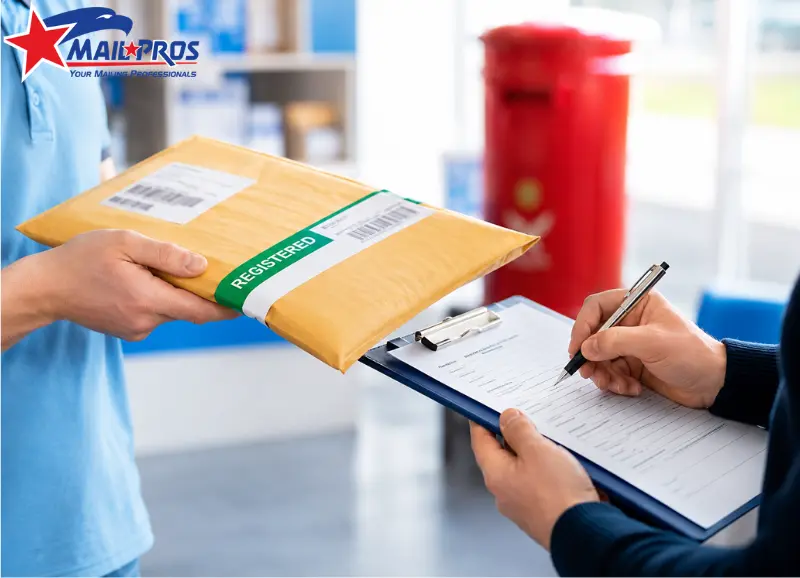
A deed and a routine account notice may fit inside similar envelopes, but they carry different risks. A lost notice can usually be printed again. An original deed may be difficult and expensive to replace. That difference is where Registered Mail becomes useful.
Registered Mail is the most secure domestic mail service offered by the United States Postal Service. It provides proof of mailing, controlled handling, a delivery signature, and value-based insurance up to $50,000. Addtionally, suits valuable or hard-to-replace contents when protection matters more than speed or price.
It is not premium package tracking. Customers receive delivery or attempted-delivery information, not a stream of facility scans. That limit matters when an item is urgent.
What Registered Mail Actually Protects?
Security Begins When USPS Accepts the Item
Registration can be added to First-Class Mail, Priority Mail, or USPS Ground Advantage. The class sets the base postage and expected delivery window. Registration adds stricter handling and custody receipts from acceptance through delivery.
Custody Records Are Different From Live Tracking
Internal custody records do not appear as normal en route scans on the public postal tracking page. The sender can check delivery or attempted delivery. Detailed records are generally accessed through an inquiry or claim.
This matters for time-sensitive document delivery because secure processing may add time. Marketing-mail visibility uses different reporting tools. The guide to how USPS tracking helps measure direct mail ROI explains how campaign signals support delivery planning without proving a sale.
When the Added Security Is Worth the Cost?
Valuable or Irreplaceable Contents
This secure mail option fits jewelry, precious metals, collectibles, original certificates, negotiable instruments, and records that cannot be recreated reliably.
The sender must declare the full value. Items worth more than $50,000 may still be registered, but compensation remains capped at $50,000. Keep appraisals, photographs, or purchase records. USPS also requires this service for commercial cash transactions over $500. Cash still needs careful packaging and documentation.
Sensitive Records and Legal Notices
Original wills, deeds, contracts, securities, and corporate records may justify documented custody. A contract, agency instruction, court rule, or statute may also require a specific mailing method. The most secure option is not automatically the legally correct one.
Registered Mail vs. Certified Mail
Compare Security, Evidence, Speed, and Cost
Both services provide a mailing receipt and delivery or attempted-delivery information. Their main purposes are different.
| Factor | Registered Mail | Certified Mail |
| Primary purpose | Maximum mail security | Proof of mailing and delivery |
| Handling | Monitored through custody receipts | Handled in transit as ordinary mail |
| Insurance | Based on declared value, up to $50,000 | Not included by the Certified Mail service itself |
| Public tracking | Final delivery or attempted-delivery status | Delivery or attempted-delivery status |
| Speed | May be slower because of secure processing | Usually follows the underlying mail class |
| Starting fee | $20.90 plus postage | $5.55 plus postage |
Routine customer correspondence needs a different approach. When persuasion is the goal, the guidance on making direct mail letters earn more responses is more useful than registering each envelope.
Match the Service to the Real Risk
Certified Mail often suits replaceable tax notices, compliance letters, lease correspondence, and account records. Registered service is stronger when the item itself has substantial value or needs tighter custody.
Other shipping services may suit parcels needing speed, regular mail tracking, insurance, or a signature. For promotion, direct mail marketing services focus on audience selection, printing, postal preparation, and response measurement.
How to Prepare and Send the Mailpiece?

Use Packaging That Shows Tampering
Choose a strong envelope or box. USPS does not accept padded envelopes, plastic mailers, Tyvek-style mailers, or glossy-coated envelopes for this service. Seal packages with glue, mucilage, or plain paper or cloth tape. The tape must absorb a postmark and show damage if removed.
Postal employees cannot seal the item. Copy the contents, verify the address, and avoid any envelope that appears opened and resealed. Disclose fragile contents and describe the interior packing.
Keep a Complete Mailing Record
At a Post Office counter, complete PS Form 3806, declare the full value, select the mail class, and choose any Return Receipt or Restricted Delivery. Review all entries before paying.
Keep the receipt, article number, content copy, and value evidence together. Mail early when a deadline applies. If delivery is disputed, these records are more useful than an article number saved alone.
Cost and Business Mailing Considerations
Review the Current Fees Before Mailing
The USPS price list effective July 12, 2026 lists a $20.90 starting fee for an item with no declared value, plus postage. The fee is $21.50 for values from $0.01 through $100. Restricted Delivery adds $8.80.
An electronic Return Receipt costs $2.91, while a paper receipt costs $4.65. It gives the sender a copy of the delivery record and signature. Verify current rates before budgeting.
Separate Secure Delivery From Customer Outreach
Registering promotional letters adds cost without improving the offer or audience. Reserve accountable mail for pieces that need it. Business mailing, direct mail marketing, and targeted mail marketing focus on reaching suitable prospects efficiently.
Campaigns needing a digital preview can use USPS Informed Delivery for direct mail. It can give eligible promotional mail earlier visibility, but it does not replace custody controls.
Targeted campaigns can narrow outreach by location, household traits, or business criteria. That keeps the budget focused on relevant prospects instead of unnecessary secure shipping fees.
Frequently Asked Questions
How Long Does Registered Mail Take?
There is no separate guaranteed timeline. The underlying class provides an expected window, but secure handling may add time.
Does Registered Mail Require a Signature?
Yes. Purchase a Return Receipt when a mailed or electronic copy of the signature record is needed.
Can Registered Mail Be Tracked Online?
USPS provides delivery or attempted-delivery status, not normal facility-by-facility scans during transit.
What Is the Difference Between Registered Mail and Certified Mail?
Certified Mail focuses on mailing and delivery proof. Registration adds stronger custody controls and value-based insurance. Verify the required legal method before sending a notice.
How Much Does Registered Mail Cost?
The fee starts at $20.90 plus postage. The final amount depends on value, mail class, weight, destination, and add-ons.
Conclusion
Registered Mail fits items whose loss, theft, or uncontrolled handling would justify added cost and time. Certified Mail or another option is usually better for replaceable notices and urgent parcels. Evaluate value, deadlines, evidence requirements, and replacement difficulty before mailing.
A useful campaign brief should identify the audience, offer, format, quantity, response method, and preferred delivery period. It should also name the person responsible for approving data and artwork. Once those details are ready, contact Mail Pros USA for a workable printing and mailing plan. Request a quote today and move the next business mailing into production.