Large Mailing Lists: Why More Reach Doesn’t Mean More Revenue


Whilst it may seem that increasing a mailing list size will increase the number of sales, mail marketers understand this is often not the case. Typically, large mailing lists include a high proportion of non-buyers and all recipients incur expenses for printing, postage and a list rental cost.
Subtly, the impact of these inefficient mailing lists is seen in poor response rates and increasing unit costs. Frequently, fault is placed with the marketing message or its presentation but, in fact, it is often the mailing list that is at fault.
A Large Mailing List Raises Your Cost Per Sale
Printing, postage and list rental are all charged on the basis of volume, number of items and number of names respectively. None of these depend upon whether the recipient can utilise the goods or service being promoted.
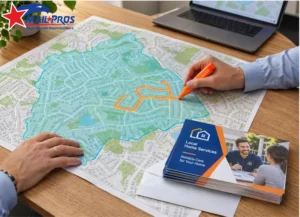
Therefore, as large mailing lists are frequently compiled by including all households within a ZIP code or all businesses within a general sector, costs increase proportionally despite there being little change in the actual number of viable prospects.
Postage Spent On Non-Buyers
Imagine a Phoenix-based plumbing firm mails out 40,000 postcards at around 55 cents each. If 30,000 of these go to apartment buildings, then it is the property management that contacts a plumber, not the occupant.
Thus, some $16,500 has been spent on postcards for people who are unable to engage a plumber. Often, more frequently than appreciated, direct mail suffers from exactly this issue. Usually, this occurs because there has been no pre-screening of a mailing list to establish who owns their home.
Address Decay And Duplicate Records
In addition to automatically expiring, data also suffers from duplication. According to the Census Bureau’s American Community Survey, almost 40 million people relocated within the U.S. in 2024. Consequently, even a large mailing list that was current as recently as in spring is already becoming outdated.
The USPS requires that commercial mailers undertake a recognised ‘Move Update’ procedure (most commonly NCOALink) no more than 95 days prior to a mailing date if they wish to qualify for discounted commercial postage rates. A good quality mailing list cleansing service will combine this Move Update with CASS standardisation and DPV validation. The latter ascertains whether or not an address is deliverable.
Business mailing lists can become dated even more quickly. Individuals’ jobs evolve, and businesses relocate. Prior to reprinting, amend your B2B mailing list if it exhibits signs of being outdated.
List Quality Drives Response More Than List Size
People respond best to mail that is relevant to them. Again, this is affected by who is included on a list. The quality of a mailing list is fundamental to the sales that can then be generated regardless of the quantity of mail that is printed.
Past Customers Versus Rented Names
ANA studies have consistently shown that previously purchased lists are more effective than rented lists. Existing customers are familiar with and confident about a brand and its goods. Conversely, rented lists include people who have no relationship with a business.
Businesses must continue to add to their customer database. Rented direct mail lists are valuable because each name can be made to appear as though it belongs to a current customer.
A Simple Cost Per Sale Comparison
Although a response rate can tell us something, we must analyse data further using a sales cost metric. Let us compare two example mailings promoting identical goods and services.
- Mailing 50,000 broad records at 55 cents each costs $27,500. A 0.5 percent response brings 250 leads, and closing one in five produces 50 sales at $550 apiece.
- Mailing 15,000 targeted records at 65 cents each, with a higher list fee built in, costs $9,750. A 2 percent response brings 300 leads, and closing one in four produces 75 sales at $130 apiece.
Around a third of the cost is incurred on this specialised mailing. It also secures 25 extra sales. Although wider lists deliver mail to more households, they falter on the single most important metric – cost effectiveness. Specialised targeted mailing services compile databases containing just those names that fit a company’s ideal customer description.
Warning Signs Of An Overbuilt Mailing List
Overly extensive mailing lists often betray themselves.
- As a list becomes broader, so does the decline in response rates despite the mail continuing to promote the same goods or service.
- There is a constant return of undeliverable mail.
- Whilst the entire metropolitan region receives mailings, orders tend to be made predominantly within specific areas.
- The marketing lists had been compiled purely according to volume and had not been analysed to identify characteristics such as occupation, homeownership status and financial bracket.
- Within the team, no-one is able to state which segment sold goods last month.
If two or more of these issues exist, then the extensive mailing list includes superfluous names.
When Wide Coverage Still Makes Sense
For certain companies it is correct to seek to distribute mailings to every household. For instance, a pizzeria, after-hours medical centre and garden maintenance company all provide services that most local households can find useful.
Extensive screening of names would therefore simply weed out customers. Both Every Door Direct Mail and saturation mailing lists ensure that all residential addresses along designated postman delivery routes receive mail. Saturation mailings also benefit from economical postal charges.
By contrast, with more specialised services such as kitchen refurbishment, industrial heating/air conditioning and eldercare, a particular market segment is targeted. Almost without exception, specialised mailing lists will outperform extensive mailing lists in these instances.
Five Ways To Make A Large Mailing List Profitable
Clean Before Every Drop
Before every campaign, run NCOA, CASS, and DPV, as well as duplication checks. Exclude people whose address has previously failed to accept post and also those who have signed up for the ANA’s DMAchoice, a mail opt out facility. Just as you check artwork for errors, so should you check your mailing list. Good mailing list management involves analysing which entries have been amended or deleted.
Segment By Buying Behavior
Customers can be categorised so that they receive tailored communications. Typically, people can be analysed based on when they last bought, how often they buy and their overall spending. Encourage customers who purchased recently to re-buy. Those who haven’t purchased for a year require incentives to shop again. People who only ever buy once may prefer to receive offers in a pack. Appropriate promotional material is thus always being targeted at a person’s relationship with a brand.
Model Prospects On Best Buyers
Extract your highest spending from 20 per cent of customers. Investigate if there are commonalities between these, for instance property value, household or business turnover and the size of the business. Where the mailing list is for businesses, SIC and NAICS codes together with the number of employees are generally used for screening.
Supply this information to direct mail list suppliers and request that they select suitable lists based on these characteristics. Should your best customers tend to live on particular streets then analysing the effectiveness of street and ZIP code targeting will tell you which demarcation is most appropriate. Targeting an audience using actual customer profiling results in both a reduced mailing list and far greater quality of potential customers.
Test Small Before Rolling Out
Initially mail 3,000-5,000 entries from a new mailing list. With this, simultaneously mail a section of your house mailing list too. Once response rates stabilise, analyse the cost per sale for both. Only those segments with a better performance than the house mailing list are then deployed. Breaking up large mailing lists for piloting is both cost effective and enables you to assess which direct mail lists are worthy of re-ordering.
Track Each Segment Separately
Whilst an overall response rate will disguise which segments are and aren’t successful, allocate unique promotion codes, QR codes and/or telephone monitoring numbers to each. Following two or three mailings, you can see which segments are profitable. Often teams lack the resources to analyse results, so utilise direct mail marketing services that can implement and analyse performance for each segment.
Frequently Asked Questions
What Size Should A Mailing List Be?
Whilst ensuring that the list encompasses all potential customers in your area, larger lists are more effective if a good level of data matches the marketing. Even for localised mailshots, a select smaller list is often a better option than one covering an entire county.
How Frequently Should A Mailing List Be Updated?
Prior to each mailing, update a list. The USPS demands that Move Updates are completed within 95 days of the mailing date in order to qualify for commercial rates. During this process, a mailshot list is also de-duplicated. Good practice in mailshot list updating means that only those at their current address pay for mail.
Does Increasing Size Reduce Unit Costs?
Generally, print and postal costs per item fall with increased volume. This will often make a larger list appear more economical. However, it is cost per sale that is key. Only by ensuring that your mailshot list is of high quality can you hope to convert reduced unit costs into profits.
Should You Purchase Or Create A Mailing List?
For the majority of organisations, a combination of the two is ideal. An internally created customer list is most effective. Marketing lists can also be purchased to attract new customers. Ensure that the direct mail lists available for hire are suitable for your customer base and always opt for specialised, rather than general, lists.
How Is A Mailing List Segmented?
Following an analysis of customers’ most recent activity, how often they transact and what they spend, further divide a list using geographical data. Mailshot lists can then be personalised for different segments. Moreover, as each segment can be allocated its own analytical code, customer segmentation also facilitates analysis.
Bottom Lines
Although volume is relatively straightforward to manage, sales are driven by relevance. Combining an up-to-date list with appropriate segmentation and undertaking preliminary small-scale mailshots means that a mailing list can become a productive sales asset. Precise audience focusing in this way also reduces cost per sale for all subsequent mailshots.
Ensure that your next large mailing list has been analysed and updated so that only key individuals receive it. MailProsUSA offers end-to-end direct mail marketing services including list acquisition, list updating, print and posting. Obtain a quotation now for specialised mailshot list analysis so that you can allocate your resources effectively to the most probable responding customers.